AI for Cybersecurity: 3-Month Implementation for U.S. Tech Leaders

Implementing AI for cybersecurity within a three-month timeframe is achievable for U.S. tech leaders by focusing on strategic planning, phased deployment, and continuous optimization to enhance threat detection and response capabilities.
In today’s rapidly evolving digital landscape, U.S. tech leaders face an urgent imperative: strengthening cybersecurity defenses against increasingly sophisticated threats. The strategic adoption of artificial intelligence (AI) offers a powerful solution, promising enhanced threat detection, automated responses, and a more resilient security posture. This guide outlines a pragmatic, step-by-step approach to successfully implementing AI cybersecurity implementation within an ambitious three-month timeline, transforming your organization’s defenses with agility and precision.
Understanding the AI cybersecurity imperative
The digital threat landscape is expanding exponentially, making traditional, signature-based security measures increasingly insufficient. AI offers a paradigm shift, moving from reactive defense to proactive threat intelligence and predictive analytics. For U.S. tech leaders, understanding this shift is the first critical step toward a more robust security framework.
AI’s ability to process vast amounts of data, identify subtle anomalies, and learn from new threats provides an unparalleled advantage. It can detect polymorphic malware, zero-day attacks, and sophisticated phishing campaigns that often bypass conventional systems. This proactive capability is not merely an enhancement; it’s a necessity for maintaining operational integrity and protecting sensitive data in a hyper-connected world.
The evolving cyber threat landscape
Cyber threats are no longer simple viruses; they are complex, adaptive, and often state-sponsored or organized criminal enterprises. These adversaries leverage AI themselves, making AI-driven defense mechanisms essential. Organizations must move beyond basic firewalls and antivirus solutions to embrace intelligent systems that can anticipate and neutralize threats before they cause significant damage.
- Advanced Persistent Threats (APTs): Stealthy and long-term attacks requiring sophisticated detection.
- Ransomware 2.0: More intelligent, targeted, and harder to decrypt, often leveraging AI to evade detection.
- Supply Chain Attacks: Exploiting vulnerabilities in trusted third-party providers, demanding comprehensive monitoring.
- Insider Threats: Malicious or accidental actions by employees, often detectable through behavioral analytics.
Embracing AI in cybersecurity is not just about technology adoption; it’s about fundamentally rethinking security strategy to meet modern challenges. It’s about leveraging machine learning algorithms to identify patterns in network traffic, user behavior, and system logs that human analysts might miss. This proactive stance is crucial for U.S. tech leaders aiming to protect their assets and maintain trust with their stakeholders.
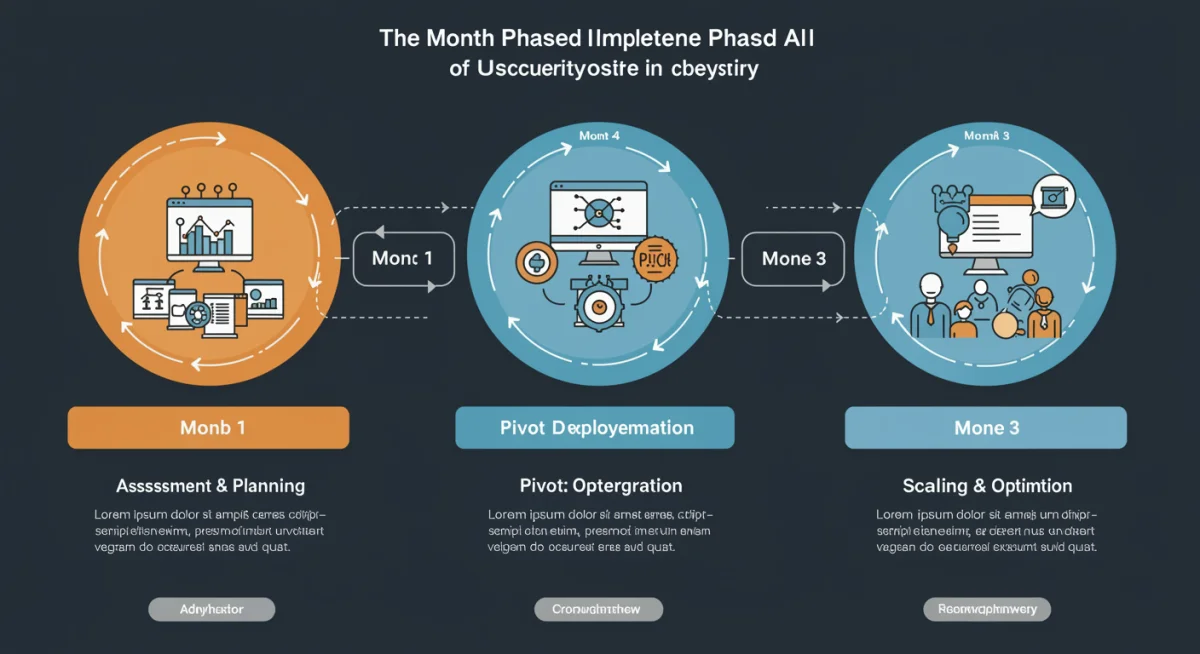
Month 1: Foundation and strategic planning
The initial month is dedicated to laying a solid foundation for your AI cybersecurity initiative. This involves a comprehensive assessment of current infrastructure, defining clear objectives, and assembling the right team. Thorough planning at this stage ensures that subsequent phases are executed smoothly and efficiently, minimizing potential roadblocks.
Begin by conducting an in-depth audit of your existing cybersecurity tools, processes, and vulnerabilities. Identify critical assets that require the highest level of protection and understand the types of threats your organization is most susceptible to. This assessment will inform the scope and focus of your AI implementation, ensuring that resources are allocated effectively.
Assessing current cybersecurity posture
Understanding your baseline is paramount. This involves not only technical evaluations but also a review of your security policies and incident response procedures. Engage with key stakeholders across IT, legal, and compliance departments to gain a holistic view of your security landscape and identify areas where AI can provide the most significant impact.
- Vulnerability Scanning: Identify known weaknesses in systems and applications.
- Penetration Testing: Simulate attacks to uncover exploitable flaws.
- Log Analysis: Review historical security event data to understand common attack vectors.
- Policy Review: Ensure current policies align with best practices and regulatory requirements.
Once the assessment is complete, define clear, measurable objectives for your AI cybersecurity project. These objectives should align with your business goals and address the most pressing security challenges identified. Establishing key performance indicators (KPIs) early on will help measure success and demonstrate the ROI of your AI investment.
Team assembly and vendor selection
Building a cross-functional team with expertise in cybersecurity, AI/machine learning, and data science is crucial. This team will drive the implementation process, from data integration to model deployment and ongoing maintenance. Furthermore, selecting the right AI cybersecurity vendor is a critical decision that requires careful consideration of their technology, support, and integration capabilities.
Evaluate potential vendors based on their proven track record, industry certifications, and alignment with your specific security needs. Look for solutions that offer scalability, ease of integration with existing systems, and robust threat intelligence feeds. A well-chosen partner can significantly accelerate your implementation timeline and enhance the effectiveness of your AI defense.
Month 2: Pilot deployment and integration
With a solid foundation in place, Month 2 focuses on the practical aspects of AI implementation: pilot deployment and integration. This phase involves selecting a high-impact, low-risk area for initial deployment, configuring the AI solution, and integrating it with existing security tools. The goal is to demonstrate tangible results quickly and build confidence in the AI’s capabilities.
Start by identifying a specific use case where AI can provide immediate value, such as enhanced endpoint detection and response (EDR) or network anomaly detection. This focused approach allows for a controlled environment to test the AI’s efficacy, fine-tune its parameters, and address any integration challenges without disrupting broader operations.
Data ingestion and model training
Effective AI relies on high-quality data. During this phase, establish robust data pipelines to ingest relevant security logs, network traffic data, and threat intelligence feeds into your AI platform. The AI models will then be trained on this data to learn normal behavior and identify deviations that indicate potential threats. This process is iterative and requires continuous monitoring and refinement.
Ensure that data sources are clean, consistent, and comprehensive. Poor data quality can lead to inaccurate detections and alert fatigue. Collaborating closely with your data engineering and security operations teams is essential to optimize data ingestion and prepare it for model training. The initial training period is crucial for the AI to develop a foundational understanding of your environment.
Integration with existing security tools
AI solutions should not operate in isolation; they must seamlessly integrate with your existing Security Information and Event Management (SIEM), Security Orchestration, Automation, and Response (SOAR), and other security tools. This integration allows for automated incident response workflows, enriched threat intelligence, and a unified view of your security posture.
- SIEM Integration: Feed AI-generated alerts and insights into your SIEM for centralized monitoring.
- SOAR Playbooks: Automate response actions based on AI-detected threats, reducing manual effort.
- Endpoint Protection Platforms (EPP): Enhance EPP capabilities with AI-driven behavioral analysis.
- Identity and Access Management (IAM): Leverage AI for abnormal user behavior detection.
Successful integration amplifies the value of your AI investment by creating a more cohesive and intelligent security ecosystem. It enables faster detection, more accurate analysis, and more efficient response to security incidents, ultimately improving your overall security resilience.
Month 3: Scaling, optimization, and continuous improvement
The final month of the initial implementation focuses on expanding the AI solution, optimizing its performance, and establishing a framework for continuous improvement. This phase transitions from pilot to broader deployment, ensuring that the AI seamlessly integrates into your daily security operations and delivers sustained value.
Begin by analyzing the results from your pilot deployment. Evaluate the AI’s accuracy in threat detection, its false positive rate, and its contribution to reducing incident response times. Use these insights to refine the AI models, adjust configurations, and prepare for wider deployment across your organization.
Expanding AI coverage and fine-tuning
Gradually extend the AI’s reach to cover more critical assets, departments, and threat vectors. This phased expansion allows for careful monitoring and adjustment, ensuring that the AI remains effective as its scope increases. Continuously fine-tune the AI models based on new data and emerging threat intelligence to maintain optimal performance.
Regularly review the AI’s performance metrics and engage with your security operations team to gather feedback. This feedback loop is essential for identifying areas for improvement, such as reducing alert fatigue or enhancing detection capabilities for specific threat types. The goal is to achieve a balance between comprehensive coverage and operational efficiency.
Establishing an AI security operations framework
Integrating AI into your Security Operations Center (SOC) requires establishing new workflows, training security analysts, and defining clear roles and responsibilities. The AI should augment human capabilities, allowing analysts to focus on complex investigations and strategic threat hunting, rather than routine alert triage.
- Analyst Training: Educate SOC teams on interpreting AI alerts and leveraging AI insights.
- Automated Playbooks: Develop and refine automated response playbooks triggered by AI detections.
- Threat Hunting: Empower analysts to use AI for proactive threat discovery and anomaly investigation.
- Performance Monitoring: Continuously track AI model performance and system health.
A well-defined AI security operations framework ensures that your AI investment is fully leveraged, transforming your SOC into a more efficient, proactive, and intelligent defense hub. This continuous improvement mindset is key to staying ahead of evolving cyber threats.
Key challenges and mitigation strategies
Implementing AI for cybersecurity, especially within a compressed timeline, inevitably presents challenges. Anticipating these obstacles and developing proactive mitigation strategies is crucial for success. U.S. tech leaders must be prepared to address issues ranging from data quality to talent gaps and ensuring regulatory compliance.
One of the primary challenges is data quality and accessibility. AI models are only as good as the data they are trained on. Inconsistent, incomplete, or biased data can lead to inaccurate detections and undermine the effectiveness of your AI solution. Establishing robust data governance policies and investing in data cleansing processes are vital.
Addressing data quality and bias
Data quality is fundamental to AI success. Ensure that data sources are properly formatted, consistently collected, and representative of your operational environment. Furthermore, be vigilant about potential biases in your training data, which could lead to discriminatory or ineffective security outcomes. Regularly audit your data and models for fairness and accuracy.
- Data Governance: Implement policies for data collection, storage, and usage.
- Data Cleansing: Employ tools and processes to remove inconsistencies and errors.
- Bias Detection: Regularly analyze AI model outputs for unintended biases.
- Synthetic Data: Consider using synthetic data to augment real datasets and improve model robustness.
Mitigating data-related challenges requires a collaborative effort between data scientists, security analysts, and IT infrastructure teams. Investing in data pipelines and quality assurance processes upfront will save significant time and resources in the long run, ensuring your AI operates on a reliable foundation.
Talent gaps and ethical considerations
Another significant challenge is the shortage of skilled professionals who possess expertise in both cybersecurity and AI. Bridging this talent gap requires strategic investment in training existing staff, recruiting specialized talent, and fostering a culture of continuous learning. Moreover, ethical considerations, such as privacy and algorithmic transparency, must be addressed proactively.
Ensure that your AI systems are designed with privacy by design principles, adhering to regulations like GDPR and CCPA, even for internal U.S. operations. Maintain transparency in how AI decisions are made, especially when those decisions impact user access or data handling. An ethical AI framework builds trust and ensures responsible deployment of these powerful technologies.
Measuring success and demonstrating ROI
For U.S. tech leaders, demonstrating the return on investment (ROI) of AI cybersecurity initiatives is critical for securing ongoing support and resources. Measuring success goes beyond simply deploying the technology; it involves tracking tangible improvements in security posture, operational efficiency, and risk reduction. Establishing clear metrics from the outset is essential.
Start by defining key performance indicators (KPIs) that align with your initial objectives. These might include metrics related to threat detection rates, false positive rates, incident response times, and the overall reduction in security breaches. Regularly collect and analyze data against these KPIs to quantify the value delivered by your AI solution.
Key performance indicators for AI security
Effective measurement requires a combination of quantitative and qualitative metrics. While quantitative data provides objective evidence of improvement, qualitative feedback from security analysts offers valuable insights into operational benefits and user experience. A balanced approach provides a comprehensive view of AI’s impact.
- Mean Time to Detect (MTTD): How quickly threats are identified by AI.
- Mean Time to Respond (MTTR): How quickly incidents are contained and resolved.
- False Positive Rate: The percentage of alerts that are not actual threats, ideally reduced by AI.
- Number of Security Incidents: A reduction in successful attacks post-AI implementation.
- Analyst Efficiency: Time saved by analysts due to AI automation and insights.
Presenting these metrics in clear, concise reports to leadership and stakeholders helps justify the investment and highlight the strategic value of AI in strengthening your organization’s cybersecurity defenses. Benchmarking against industry standards can further underscore your achievements.
Long-term value and strategic advantages
Beyond immediate operational improvements, AI cybersecurity delivers significant long-term strategic advantages. It fosters a more resilient and adaptive security posture, allowing your organization to anticipate and respond to future threats with greater agility. This proactive capability is a cornerstone of digital transformation and sustained competitive advantage.
AI also enables a continuous learning loop, where the system constantly improves its understanding of threats and vulnerabilities. This adaptability ensures that your defenses remain cutting-edge, even as the threat landscape evolves. For U.S. tech leaders, this translates into reduced long-term risk and enhanced business continuity, protecting both reputation and revenue.
Future-proofing your security with AI
The journey of implementing AI for cybersecurity doesn’t end after three months; it marks the beginning of a continuous evolution. Future-proofing your security involves staying abreast of AI advancements, regularly updating your models, and exploring new applications of AI to further enhance your defensive capabilities. This forward-looking approach ensures long-term resilience.
Embrace a culture of innovation within your security teams, encouraging experimentation with new AI techniques and tools. Attend industry conferences, participate in research, and collaborate with academic institutions to remain at the forefront of AI cybersecurity developments. The rapid pace of technological change demands constant adaptation.
Emerging AI trends in cybersecurity
The field of AI is constantly evolving, with new breakthroughs emerging regularly. Keep an eye on trends such as explainable AI (XAI), which provides greater transparency into AI decision-making, and federated learning, allowing AI models to be trained on decentralized data without compromising privacy. Quantum computing’s potential impact on cryptography also warrants close monitoring.
- Generative AI for Threat Simulation: Creating realistic attack scenarios for better defense testing.
- AI-Powered Deception Technologies: Setting up AI-driven honeypots to mislead and detect attackers.
- Behavioral Biometrics: Using AI to analyze unique user interaction patterns for authentication.
- Autonomous Response Systems: Developing AI that can automatically mitigate threats with minimal human intervention.
By integrating these emerging trends into your long-term strategy, you can ensure that your AI cybersecurity framework remains robust and capable of defending against the threats of tomorrow. This proactive engagement with future technologies is a hallmark of visionary U.S. tech leadership.
Building a resilient and adaptive security culture
Ultimately, future-proofing your security with AI is about cultivating a resilient and adaptive security culture. This involves not only technological advancements but also fostering a mindset of continuous improvement, collaboration, and education across the organization. Security is a collective responsibility, and AI empowers every individual to contribute to a stronger defense.
Regular training for all employees on cybersecurity best practices, coupled with awareness campaigns about AI’s role in defense, reinforces this culture. Encourage cross-departmental collaboration between IT, security, and business units to ensure that AI initiatives are aligned with broader organizational goals and risk management strategies. A strong security culture, powered by AI, is the ultimate defense.
| Key Implementation Phase | Brief Description |
|---|---|
| Month 1: Foundation & Planning | Assess current cybersecurity, define objectives, and select AI vendor and team. Critical for strategic alignment. |
| Month 2: Pilot & Integration | Deploy AI in a controlled environment, integrate with existing tools, and train models with relevant data. |
| Month 3: Scaling & Optimization | Expand AI coverage, fine-tune performance, and establish an AI-driven security operations framework. |
| Continuous Improvement | Regularly update AI models, explore new trends, and foster an adaptive security culture for long-term resilience. |
Frequently asked questions about AI cybersecurity implementation
A 3-month timeline is realistic when focusing on a phased approach, starting with critical, high-impact areas. By leveraging existing infrastructure and selecting agile AI solutions, U.S. tech leaders can demonstrate quick wins and build momentum. Strategic planning and clear objectives from day one are crucial for this accelerated deployment.
The biggest data challenges include ensuring data quality, consistency, and sufficient volume for model training. Additionally, dealing with data privacy concerns, potential biases in datasets, and integrating disparate data sources are significant hurdles. Robust data governance and cleansing processes are essential to overcome these issues effectively.
AI integrates by feeding its intelligent alerts and insights into SIEM systems for centralized monitoring and correlation. With SOAR platforms, AI can trigger automated response playbooks, streamlining incident handling. This synergy enhances threat intelligence, reduces manual tasks, and accelerates the overall incident response lifecycle for security teams.
An effective team requires a blend of cybersecurity analysts, data scientists with machine learning expertise, and IT infrastructure specialists. Knowledge of network protocols, threat intelligence, programming languages (Python, R), and cloud platforms is highly beneficial. Continuous training and upskilling are vital to keep pace with evolving technologies and threats.
ROI can be measured through key metrics such as reduced mean time to detect (MTTD) and respond (MTTR) to threats, decreased false positive rates, and a lower number of successful security breaches. Quantifying the efficiency gains in security operations, such as time saved by analysts, also provides a strong business case for AI investments.
Conclusion
Implementing AI for cybersecurity in 3 months is an ambitious yet achievable goal for U.S. tech leaders committed to elevating their organization’s defense capabilities. By following a structured, phased approach that prioritizes thorough planning, strategic pilot deployment, and continuous optimization, companies can rapidly integrate AI to detect and respond to threats with unprecedented speed and accuracy. This journey not only strengthens immediate security posture but also establishes a foundation for long-term resilience, ensuring that your organization remains protected against the evolving landscape of cyber threats. Embracing AI is no longer an option but a strategic imperative for safeguarding digital assets and maintaining trust in the modern era.