RPA Software Implementation: 3-Month Plan for 30% Productivity Boost

Implementing RPA software effectively can lead to a substantial 30% productivity boost within three months by streamlining operations and automating repetitive tasks across various business functions.
Implementing RPA Software for a 30% Boost in Productivity: A 3-Month Action Plan (Practical Solutions)
In today’s competitive landscape, businesses are constantly seeking innovative ways to enhance efficiency and drive growth. One of the most transformative technologies emerging is Robotic Process Automation (RPA). This article delves into a practical, actionable 3-month plan for implementing RPA software, aiming for a remarkable 30% boost in your organization’s productivity. We’ll explore the essential steps, considerations, and practical solutions to navigate this journey successfully, ensuring your investment yields tangible results.
Month 1: Assessment, Planning, and Foundation Laying
The initial month of your RPA journey is critical for setting a strong foundation. This phase involves thorough assessment, meticulous planning, and establishing the necessary infrastructure. Rushing this stage can lead to significant challenges down the line, so a deliberate approach is paramount for long-term success.
Identifying Automation Opportunities
The first step is to pinpoint processes ripe for automation. Not all tasks are suitable for RPA, and selecting the right ones is crucial for demonstrating early value. Look for processes that are:
- Repetitive and high-volume
- Rule-based and standardized
- Prone to human error
- Time-consuming for employees
Engaging with departmental heads and process owners is vital here. They possess invaluable insights into daily operations and bottlenecks. Conducting workshops to map out current processes and identify pain points can uncover hidden automation potential, leading to more impactful RPA deployments.
Building the RPA Core Team
A dedicated and skilled team is the backbone of any successful RPA implementation. This team typically includes:
- RPA Project Manager: Oversees the entire implementation, ensuring timelines and objectives are met.
- Business Analyst: Bridges the gap between business needs and technical solutions, defining process requirements.
- Solution Architect: Designs the overall RPA solution, ensuring scalability and integration.
- RPA Developers: Build and configure the bots according to the defined specifications.
- Infrastructure Engineer: Ensures the necessary IT infrastructure is in place for RPA deployment.
Investing in training for existing staff or hiring new talent with RPA expertise will significantly accelerate your progress. A cross-functional team fosters better understanding and collaboration, which is essential when integrating RPA into diverse business units.
Vendor Selection and Initial Setup
Choosing the right RPA vendor is a pivotal decision. Evaluate vendors based on their platform’s capabilities, scalability, support, and cost-effectiveness. Consider factors like ease of use, integration capabilities with existing systems, and their ecosystem of partners and training resources.
Once a vendor is selected, the initial setup involves installing the RPA software, configuring environments (development, testing, production), and establishing security protocols. This foundational work ensures a stable and secure platform for your automation efforts. It’s also wise to establish a governance framework that defines roles, responsibilities, and best practices for bot development and deployment.
Month 1 is about laying the groundwork, understanding your business processes, assembling the right team, and selecting the appropriate technology. This careful preparation ensures that subsequent phases of the RPA implementation are smooth and effective, maximizing your chances of achieving that 30% productivity boost.
Month 2: Pilot Program, Development, and Testing
With the foundations laid, Month 2 shifts focus to the practical application of RPA through a pilot program. This phase is where theoretical plans begin to transform into tangible automated processes, allowing for real-world testing and refinement.
Selecting and Developing Pilot Processes
The pilot program should target one or two high-impact, low-complexity processes identified in Month 1. The goal is to demonstrate quick wins and build internal confidence in RPA’s capabilities. These initial successes are crucial for gaining broader organizational buy-in and momentum for future automation initiatives.
RPA developers will work closely with business analysts to design and configure the bots. This involves creating detailed process documentation, developing automation scripts, and integrating them with relevant applications. Iterative development, where small segments of the process are automated and tested, is often the most effective approach.
Rigorous Testing and Quality Assurance
Testing is an indispensable part of the development cycle. Bots must be thoroughly tested to ensure they perform accurately, reliably, and securely. This includes:
- Unit Testing: Verifying individual components of the bot.
- System Integration Testing: Ensuring the bot interacts correctly with all integrated systems.
- User Acceptance Testing (UAT): Business users validate that the bot meets their requirements and performs as expected.
- Performance Testing: Assessing the bot’s speed and efficiency under various loads.
Any identified errors or discrepancies must be promptly addressed and retested. A robust quality assurance process minimizes risks and ensures the automated processes deliver the intended productivity gains without introducing new problems. Documentation of test cases and results is also vital for future maintenance and auditing.
User Training and Change Management
As bots are developed and tested, it’s equally important to prepare the human workforce. RPA often changes existing job roles, and effective change management is essential to mitigate resistance and foster adoption. Provide comprehensive training to employees who will interact with the bots or whose tasks will be impacted.
Focus on communicating the benefits of RPA, such as freeing up employees from mundane tasks to focus on more strategic, value-added activities. Highlight how RPA enhances efficiency, reduces errors, and improves overall job satisfaction. Establishing an internal communication plan that addresses concerns and celebrates early successes can significantly aid in this transition.
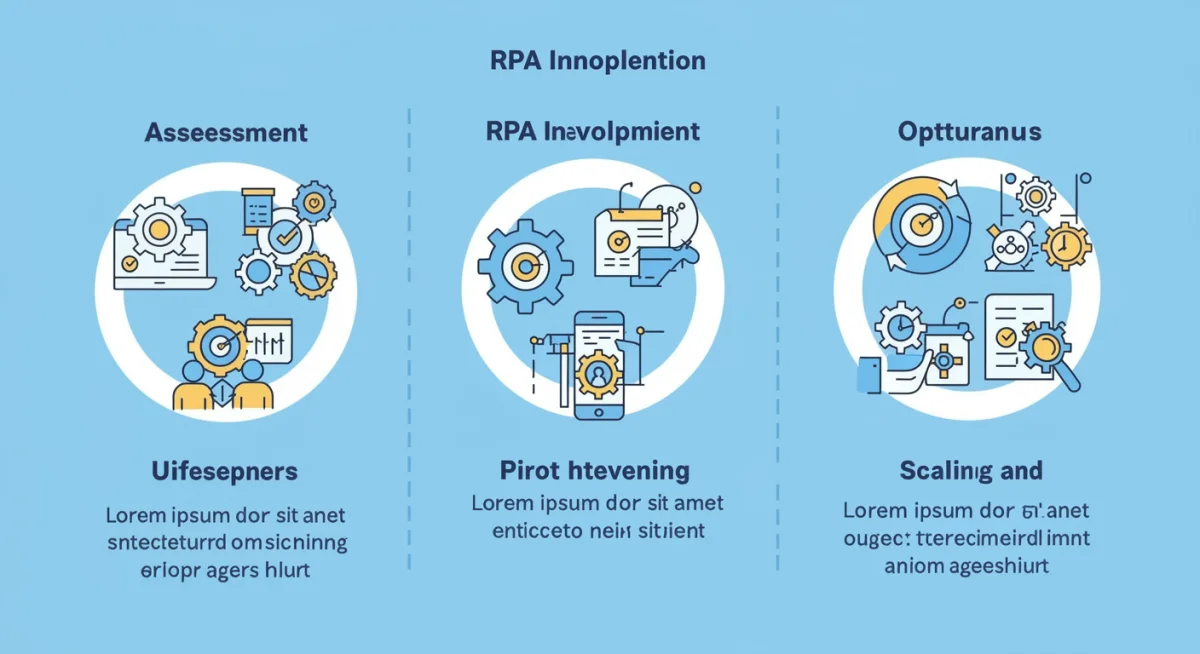
Month 2 is a period of intense activity, where the theoretical framework from Month 1 is put into practice. Successful pilot programs and effective change management during this stage are crucial for demonstrating the immediate value of RPA and paving the way for broader adoption and significant productivity improvements.
Month 3: Scaling, Optimization, and Continuous Improvement
The final month of our 3-month action plan focuses on expanding the scope of RPA, optimizing deployed bots, and establishing a framework for continuous improvement. This phase is about transitioning from pilot success to enterprise-wide impact, solidifying the 30% productivity boost.
Expanding Automation to New Processes
Building on the success of the pilot program, the team can now strategically identify and automate additional processes. Prioritize processes that offer the highest return on investment (ROI) and align with strategic business objectives. This expansion should follow a structured approach, applying lessons learned from the pilot phase.
- Phased Rollout: Introduce new bots gradually to manage complexity and ensure stability.
- Standardized Development: Leverage templates and best practices established during the pilot to accelerate development.
- Cross-Departmental Collaboration: Work with various departments to identify their specific automation needs and integrate RPA solutions seamlessly.
The aim is to create a pipeline of automation projects, ensuring a steady stream of productivity gains across the organization. Regular communication with stakeholders helps manage expectations and keeps everyone informed of progress.
Performance Monitoring and Optimization
Once bots are in production, continuous monitoring of their performance is essential. This involves tracking key metrics such as:
- Bot Uptime and Reliability: Ensuring bots are operational and consistently performing their tasks.
- Error Rates: Identifying and resolving any errors promptly to maintain accuracy.
- Processing Time: Measuring the efficiency of automated tasks compared to manual execution.
- Productivity Gains: Quantifying the actual time and cost savings achieved by RPA.
Regular performance reviews allow for optimization opportunities. This could involve refining bot logic, updating integrations, or even re-engineering underlying business processes to further enhance efficiency. The goal is to maximize the impact of each deployed bot and ensure it continues to deliver value.
Establishing a Center of Excellence (CoE)
For sustainable RPA growth, establishing a Center of Excellence (CoE) is highly recommended. An RPA CoE acts as a central hub for all automation activities, providing governance, best practices, training, and support across the organization. Its responsibilities include:
- Defining RPA strategy and roadmap.
- Developing and enforcing automation standards.
- Providing technical guidance and support.
- Managing the RPA platform and infrastructure.
- Facilitating knowledge sharing and innovation.
A well-structured CoE ensures that RPA initiatives are aligned with business goals, scalable, and resilient. It fosters a culture of automation, encouraging employees to identify new opportunities and participate in the ongoing evolution of the RPA program.
Month 3 is about cementing RPA as a core component of your operational strategy. By scaling automation, continuously optimizing performance, and establishing a CoE, your organization can sustain and even exceed the initial 30% productivity boost, realizing the full transformative potential of RPA.
Selecting the Right RPA Software: Key Considerations
Choosing the appropriate RPA software is a critical decision that can significantly impact the success of your implementation. The market offers a variety of solutions, each with its unique strengths. Understanding your specific needs and evaluating platforms against key criteria will guide you to the best fit for your organization.
Scalability and Flexibility
Your chosen RPA platform should be able to grow with your business. Consider its ability to handle an increasing number of bots, processes, and integrations without compromising performance. A flexible platform will allow you to adapt to evolving business requirements and technological advancements. Look for solutions that offer both attended and unattended automation capabilities, providing versatility for different use cases.
Integration capabilities are also paramount. The software should seamlessly connect with your existing enterprise applications, databases, and legacy systems. APIs and pre-built connectors can simplify this process, reducing development time and effort. A platform that supports a wide range of application types, from web-based to desktop applications, offers greater utility.
Ease of Use and Development
While technical expertise is required, a user-friendly interface and intuitive development environment can accelerate bot creation and reduce the learning curve for your team. Look for features such as:
- Low-Code/No-Code Capabilities: Empowering business users to participate in automation development.
- Visual Workflow Designers: Simplifying the mapping and design of automated processes.
- Pre-built Components and Templates: Speeding up development and ensuring consistency.
- Comprehensive Documentation and Training: Supporting developers and users in mastering the platform.
A platform that simplifies bot development allows your team to focus more on strategic automation opportunities rather than getting bogged down by complex coding. This can lead to faster deployment cycles and quicker realization of benefits.
Security and Governance
RPA bots often handle sensitive data and interact with critical systems, making security a top priority. The chosen software must offer robust security features, including:
- Role-Based Access Control (RBAC): Limiting access to bots and data based on user roles.
- Encryption: Protecting data at rest and in transit.
- Audit Trails: Logging all bot activities for compliance and troubleshooting.
- Compliance Certifications: Adhering to industry standards and regulations.
Beyond technical security, the platform should support strong governance frameworks. This includes features for managing bot lifecycles, version control, and change management. A secure and well-governed RPA environment instills confidence and minimizes operational risks, which is essential when automating core business functions.
By carefully evaluating these aspects, organizations can select an RPA software solution that not only meets their immediate automation needs but also provides a scalable, secure, and user-friendly foundation for future growth and continued productivity enhancements.
Measuring and Sustaining the 30% Productivity Boost
Achieving a 30% productivity boost through RPA is an ambitious yet attainable goal. However, simply deploying bots isn’t enough; organizations must diligently measure the impact and establish mechanisms to sustain these gains over the long term. This requires a strategic approach to monitoring, evaluation, and continuous adaptation.
Defining Key Performance Indicators (KPIs)
Before and after RPA implementation, it’s crucial to define clear KPIs to quantify the productivity improvements. These might include:
- Cycle Time Reduction: The decrease in time taken to complete a process.
- Error Rate Reduction: The drop in human errors in automated tasks.
- Cost Savings: Financial benefits from reduced manual effort and rework.
- Employee Satisfaction: Improvements in morale due to offloading repetitive tasks.
- Throughput Increase: The higher volume of tasks processed within the same timeframe.
Baseline measurements should be taken before automation begins. Regular reporting against these KPIs provides objective evidence of RPA’s impact and helps justify further investment. Tools for analytics and dashboards integrated with your RPA platform can provide real-time insights into bot performance and business outcomes.
Continuous Monitoring and Maintenance
RPA bots are not ‘set it and forget it’ solutions. They require ongoing attention to ensure optimal performance. Business environments, applications, and regulations can change, potentially affecting bot functionality. Therefore, continuous monitoring is non-negotiable.
Establish a dedicated support team responsible for:
- Proactive Monitoring: Using alerts and dashboards to detect issues early.
- Troubleshooting and Incident Management: Quickly resolving any bot failures or errors.
- Scheduled Maintenance: Performing regular updates and health checks on bots and the RPA platform.
- Adaptation to Changes: Modifying bots to accommodate system updates or process alterations.
A robust maintenance strategy prevents performance degradation and ensures the sustained reliability and efficiency of your automated processes. This proactive approach safeguards your productivity gains and extends the lifespan of your RPA investments.
Fostering an Automation-First Culture
To truly sustain and expand productivity benefits, RPA must become ingrained in the organizational culture. This means encouraging employees at all levels to identify new automation opportunities and embrace digital transformation. An automation-first culture can be cultivated through:
- Internal Communication: Regularly sharing success stories and the benefits of automation.
- Rewards and Recognition: Acknowledging employees who champion automation initiatives.
- Training and Upskilling: Providing opportunities for employees to learn about RPA and contribute to its development.
- Leadership Endorsement: Senior management actively promoting and supporting RPA.
When employees feel empowered and see the value in automation, they become advocates, further propelling the organization towards greater efficiency and innovation. This cultural shift is perhaps the most powerful driver for sustaining and exceeding the initial 30% productivity boost from RPA.
Navigating Challenges in RPA Implementation
While the benefits of RPA are substantial, the implementation journey is not without its challenges. Proactively identifying and addressing potential hurdles is crucial for a smooth deployment and for realizing the targeted 30% productivity boost. Awareness and preparedness can turn obstacles into opportunities for refinement and stronger results.
Resistance to Change
One of the most common challenges is human resistance to change. Employees may fear job displacement, feel uncomfortable with new technologies, or be reluctant to alter established workflows. This can lead to slow adoption, disengagement, and even active sabotage of RPA initiatives.
To counter this, a comprehensive change management strategy is vital. This includes:
- Transparent Communication: Explaining the ‘why’ behind RPA and its benefits for both the organization and employees.
- Early Involvement: Engaging employees in the process identification and design phases.
- Training and Reskilling: Providing opportunities for employees to learn new skills and transition to higher-value roles.
- Addressing Concerns: Openly discussing fears and providing reassurance about job security and career growth.
Framing RPA as a tool that augments human capabilities rather than replaces them can significantly improve acceptance and foster a collaborative environment.
Process Complexity and Documentation Gaps
Many business processes, especially in larger organizations, are more complex and less standardized than initially perceived. Poorly documented processes, reliance on tribal knowledge, and numerous exceptions can make automation challenging. Bots thrive on clear, rule-based instructions, and ambiguity can lead to errors and rework.
Before automating, invest time in thoroughly documenting and optimizing processes. This may involve:
- Process Mapping: Visually charting every step of a process.
- Standardization: Eliminating unnecessary variations and exceptions.
- Detailed Documentation: Creating clear, step-by-step guides for bot developers.
- Exception Handling: Designing specific protocols for unusual scenarios.
Simplifying and standardizing processes not only makes them easier to automate but also improves their overall efficiency, regardless of RPA implementation.
Scalability and Maintenance Issues
As RPA adoption grows, organizations can face challenges related to scalability and ongoing maintenance. A poorly designed architecture can struggle to support an increasing number of bots, leading to performance bottlenecks. Additionally, changes in underlying IT systems or applications can break existing bots, requiring constant maintenance and updates.
To address these issues:
- Robust Architecture: Design a scalable RPA infrastructure from the outset.
- Modular Bot Design: Build bots with reusable components to simplify maintenance.
- Centralized Governance: Establish a CoE to manage bot lifecycles and ensure consistency.
- Proactive Monitoring: Implement tools to monitor bot performance and health continuously.
Anticipating these challenges and building resilience into your RPA strategy will help ensure that your automation efforts continue to deliver value and sustain the desired productivity gains without becoming an operational burden.
Future-Proofing Your RPA Investment
The landscape of automation is constantly evolving, with new technologies and approaches emerging regularly. To ensure your RPA investment continues to deliver significant value and contributes to a sustained 30% productivity boost, it’s essential to future-proof your strategy. This involves looking beyond current implementations and preparing for the next wave of intelligent automation.
Integrating with AI and Machine Learning
RPA is powerful for automating structured, rule-based tasks. However, its effectiveness can be dramatically enhanced by integrating with Artificial Intelligence (AI) and Machine Learning (ML). This convergence creates ‘Intelligent Automation,’ enabling bots to handle more complex, unstructured data and decision-making processes.
Consider integrating RPA with:
- Optical Character Recognition (OCR): To extract data from unstructured documents like invoices or forms.
- Natural Language Processing (NLP): To understand and process human language in emails or customer queries.
- Machine Learning Algorithms: For predictive analytics, anomaly detection, and intelligent decision support.
These integrations allow RPA bots to perform tasks that traditionally required human cognitive abilities, opening up new frontiers for automation and further increasing efficiency and accuracy across various business functions.
Embracing Process Mining and Discovery
To continuously identify new and optimal automation opportunities, organizations should leverage process mining and discovery tools. These technologies analyze event logs from IT systems to reconstruct and visualize actual business processes, revealing bottlenecks, inefficiencies, and hidden variations that might not be apparent through manual process mapping.
Process mining helps in:
- Objective Process Analysis: Providing data-driven insights into how processes truly operate.
- Identifying Automation Candidates: Pinpointing the most impactful processes for RPA.
- Optimizing Existing Processes: Revealing areas for improvement even before automation.
- Monitoring Compliance: Ensuring processes adhere to defined rules and regulations.
By continuously analyzing their processes, organizations can maintain a robust pipeline of automation projects, ensuring that their RPA strategy remains dynamic and responsive to evolving business needs, thereby securing long-term productivity advantages.
Cultivating a Culture of Continuous Innovation
The most effective way to future-proof your RPA investment is to foster an organizational culture that embraces continuous innovation and learning. This means encouraging experimentation, celebrating successes, and learning from failures. An agile mindset, where iterations and rapid deployment are valued, can keep your automation initiatives at the forefront of technological advancements.
- Dedicated Innovation Labs: Explore emerging technologies and their potential application with RPA.
- Cross-Functional Collaboration: Encourage teams to share insights and co-create solutions.
- Employee Empowerment: Provide tools and training for citizen developers to build simple automations.
- Industry Benchmarking: Stay informed about best practices and new trends in automation.
By actively promoting an environment where innovation thrives, your organization can ensure that its RPA strategy remains relevant, powerful, and a continuous driver of productivity and competitive advantage for years to come.
| Key Phase | Core Activities |
|---|---|
| Month 1: Foundation | Assess processes, build team, select vendor, initial setup. |
| Month 2: Pilot & Develop | Pilot process selection, bot development, rigorous testing, user training. |
| Month 3: Scale & Optimize | Expand automation, monitor performance, establish CoE for continuous improvement. |
| Sustaining Gains | KPI tracking, continuous monitoring, future-proofing with AI/ML. |
Frequently Asked Questions About RPA Implementation
The typical ROI for RPA implementation can be significant, often ranging from 30% to 200% or more within the first year. This is achieved through reduced operational costs, increased efficiency, improved accuracy, and faster process execution, freeing up human capital for higher-value tasks.
Initial results from RPA implementation can often be seen within weeks, especially with a well-planned pilot program targeting simple, high-volume processes. Significant productivity boosts, like the targeted 30%, are typically achievable within three to six months as automation scales.
Key challenges in RPA adoption include resistance to change from employees, identifying suitable processes for automation, managing process complexity, ensuring data security, and maintaining bots as systems evolve. Effective change management and a robust governance framework are crucial for overcoming these hurdles.
Absolutely. Small businesses can greatly benefit from RPA by automating repetitive administrative tasks, improving customer service, and optimizing back-office operations. Many RPA solutions offer scalable pricing models, making it accessible even for smaller organizations looking to enhance efficiency and competitiveness.
An RPA Center of Excellence (CoE) is a centralized unit that governs, manages, and supports all automation initiatives within an organization. It’s crucial for ensuring consistency, scalability, adherence to best practices, and continuous innovation, thereby maximizing the long-term success of RPA deployments.
Conclusion
The journey of implementing RPA software is a strategic investment that, when executed with precision, can profoundly transform an organization’s operational efficiency. This 3-month action plan provides a clear roadmap, guiding businesses from initial assessment and planning through to pilot development, scaling, and continuous optimization. By meticulously following these steps, addressing potential challenges proactively, and fostering a culture of automation, companies can confidently achieve a significant 30% boost in productivity. The benefits extend beyond mere efficiency, empowering employees, reducing errors, and positioning the organization for sustained growth in an increasingly automated world. Embracing RPA is not just about technology; it’s about reimagining work and unlocking unprecedented levels of business performance.