Unlocking New Revenue Streams: AI Opportunities for U.S. Startups by 2027

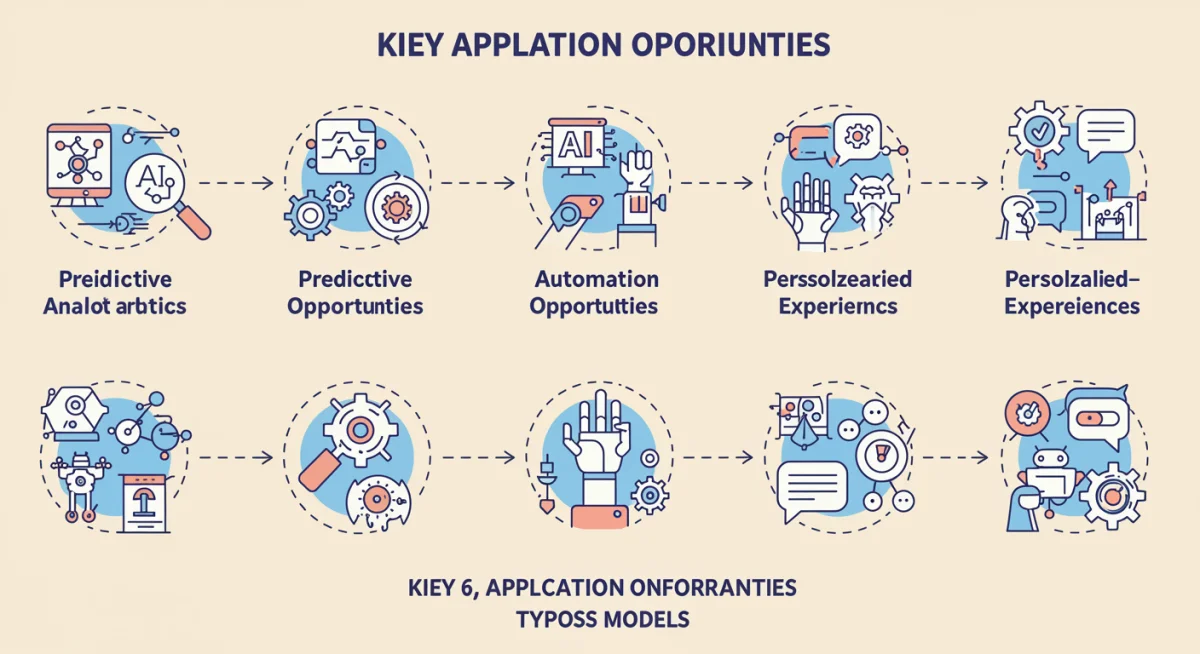
U.S. startups can unlock substantial new revenue streams by strategically implementing six key AI application opportunities across various sectors, driving innovation and market disruption by 2027.
The landscape for U.S. startups is consistently evolving, and a critical factor for sustained growth and market leadership lies in embracing cutting-edge technologies. Among these, artificial intelligence stands out as a paramount driver for new business models and significant profit generation. This article explores six pivotal AI application opportunities for U.S. startups by 2027, offering insights into how these innovations can unlock unprecedented revenue streams.
Hyper-personalized customer experiences
In today’s competitive market, generic customer interactions no longer suffice. Consumers expect tailored experiences that anticipate their needs and preferences. AI offers an unparalleled ability to analyze vast amounts of data, creating hyper-personalized interactions that can significantly boost customer loyalty and, consequently, revenue.
By leveraging machine learning algorithms, startups can collect and interpret data points such as purchase history, browsing behavior, social media activity, and even emotional responses to content. This deep understanding enables the delivery of highly relevant product recommendations, personalized marketing messages, and customized service interactions.
Predictive personalization engines
Startups can develop AI-powered engines that predict individual customer preferences with high accuracy. These systems move beyond simple segmentation to create a ‘segment of one,’ offering truly unique experiences.
- Dynamic content adaptation based on real-time user behavior.
- Personalized product bundles and subscription offerings.
- Proactive customer support anticipating issues before they arise.
- Tailored notifications and communication channels.
The revenue impact stems from increased conversion rates, higher average order values, and reduced churn. When customers feel understood and valued, they are more likely to engage, purchase, and remain loyal. Companies like Netflix and Amazon have long demonstrated the power of personalization, and AI makes this level of customization accessible to agile startups seeking to carve out their niche.
Advanced predictive analytics for market insights
The ability to foresee market trends, customer demand, and potential disruptions is invaluable for any business. AI-driven predictive analytics tools provide startups with a crystal ball, allowing them to make data-informed decisions that minimize risk and maximize opportunities. This foresight translates directly into optimized resource allocation and new revenue streams.
Traditional analytics often describe what has happened, but AI excels at predicting what will happen. By analyzing historical data, identifying patterns, and applying complex statistical models, AI can forecast future outcomes with remarkable precision. This capability is particularly potent for startups navigating volatile markets or introducing innovative products.
Demand forecasting and inventory optimization
AI models can analyze seasonal data, economic indicators, social media sentiment, and even weather patterns to predict demand for products and services. This enables startups to optimize inventory levels, reducing waste and ensuring products are available when customers want them.
- Reduced inventory holding costs and obsolescence.
- Improved sales through better product availability.
- Dynamic pricing strategies based on forecasted demand fluctuations.
- Identification of emerging market niches and trends.
For U.S. startups, mastering predictive analytics means being several steps ahead of the competition. It allows for proactive strategy adjustments, from marketing campaigns to supply chain management, ultimately leading to more efficient operations and increased profitability. The insights gained can also inform the development of entirely new products or services tailored to anticipated future needs.
Intelligent automation and robotic process automation (RPA)
Operational efficiency is a cornerstone of startup success, and intelligent automation, particularly Robotic Process Automation (RPA) combined with AI, offers a powerful avenue for achieving it. By automating repetitive, rule-based tasks, startups can free up human capital to focus on strategic initiatives, innovation, and complex problem-solving, all while reducing operational costs and accelerating processes.
RPA bots integrated with AI capabilities like natural language processing (NLP) and machine learning can handle tasks that require interpretation or decision-making, going beyond simple rule-based automation. This includes processing invoices, onboarding new employees, managing customer inquiries, and even basic data analysis.
Streamlining back-office operations
Many startups are burdened by manual administrative tasks that consume valuable time and resources. AI-powered RPA can transform these operations, making them faster, more accurate, and less prone to human error.
- Automated data entry and report generation.
- Faster processing of financial transactions and reconciliation.
- Improved compliance and audit trails.
- Enhanced employee productivity and satisfaction.
The direct revenue impact comes from significant cost savings and increased capacity to handle growth without proportionally increasing headcount. For instance, a fintech startup could automate loan application processing, scaling its operations rapidly. Furthermore, by improving efficiency, startups can deliver services faster, enhancing customer satisfaction and attracting new clients. The ability to do more with less is a critical competitive advantage in the startup ecosystem.
Enhanced cybersecurity and fraud detection
As digital transactions and data storage become more prevalent, the threat of cyberattacks and fraud escalates. For U.S. startups handling sensitive customer information or financial transactions, robust cybersecurity is not just a necessity but a competitive differentiator. AI offers sophisticated tools to detect and prevent threats in real-time, protecting revenue, reputation, and customer trust.
Traditional security systems often rely on known threat signatures. AI, however, can identify anomalous behaviors and emerging threats by learning from vast datasets of network traffic, user activity, and transaction patterns. This proactive approach significantly reduces the window of vulnerability.
Real-time anomaly detection
AI algorithms can continuously monitor systems for unusual activity that might indicate a cyberattack or fraudulent transaction. This includes detecting login attempts from unusual locations, sudden large transfers of funds, or unauthorized access to sensitive data.
- Reduced financial losses due to fraud and data breaches.
- Protection of intellectual property and sensitive customer data.
- Increased customer confidence and loyalty.
- Compliance with evolving data protection regulations.
For startups, a strong cybersecurity posture built on AI can be a powerful selling point, especially in sectors like fintech, healthcare tech, and e-commerce. Preventing a single major data breach can save millions in recovery costs, legal fees, and reputational damage, directly safeguarding existing revenue streams and enabling the secure expansion into new markets. Offering AI-powered security as a service can also become a new revenue stream itself.
Revolutionizing healthcare with AI diagnostics
The healthcare industry is ripe for disruption, and AI is at the forefront of this transformation. U.S. startups focusing on AI diagnostics have a monumental opportunity to create new revenue streams by improving the accuracy, speed, and accessibility of medical diagnoses. This not only enhances patient outcomes but also optimizes healthcare provider workflows.
AI algorithms, particularly in fields like computer vision and machine learning, can analyze medical images (X-rays, MRIs, CT scans) and patient data with a level of precision that often surpasses human capabilities. This leads to earlier disease detection, more accurate prognoses, and personalized treatment plans.
Image analysis for early disease detection
Startups can develop AI systems that assist radiologists and pathologists in identifying subtle indicators of diseases like cancer, diabetic retinopathy, or neurological disorders from medical scans. These systems act as a second pair of eyes, reducing diagnostic errors and speeding up the process.
- Faster and more accurate diagnosis of complex conditions.
- Reduced healthcare costs through early intervention.
- Personalized treatment recommendations based on AI insights.
- Improved patient care and reduced physician burnout.
The revenue potential for healthcare AI startups is vast, stemming from partnerships with hospitals, clinics, and pharmaceutical companies. As healthcare systems seek to improve efficiency and patient outcomes while managing costs, AI diagnostics offer a compelling solution. Startups can offer their AI platforms as a service, develop specialized diagnostic tools, or even create direct-to-consumer health screening solutions, tapping into a multi-billion dollar market.
AI-powered content generation and optimization
In the digital age, content is king, but creating high-quality, engaging, and SEO-optimized content at scale is a significant challenge for businesses. AI-powered content generation and optimization tools offer a solution, enabling U.S. startups to produce compelling material efficiently, drive organic traffic, and establish thought leadership, all contributing to new and enhanced revenue streams.
Generative AI models, such as large language models (LLMs), can produce various forms of content, from blog posts and social media updates to ad copy and product descriptions. Beyond generation, AI can also optimize existing content for better search engine rankings and audience engagement.
Automated marketing copy and SEO enhancement
Startups can leverage AI to rapidly create diverse marketing materials tailored to different platforms and audiences. AI can also analyze content performance and suggest optimizations for keywords, readability, and structure.
- Scalable content creation for blogs, social media, and email campaigns.
- Improved search engine rankings and organic traffic.
- Personalized content delivery increasing engagement and conversions.
- Reduced marketing costs and faster campaign execution.
The revenue opportunities here are twofold: startups can either use these tools internally to boost their own marketing efforts, leading to increased leads and sales, or they can develop and offer AI-powered content services to other businesses. Agencies, e-commerce platforms, and media companies are all potential clients for such solutions, creating a robust market for innovative content AI startups. The ability to quickly and effectively communicate a brand’s message is invaluable in today’s crowded digital space.
| Key Opportunity | Revenue Impact |
|---|---|
| Hyper-personalization | Increases conversion rates, customer loyalty, and average order values. |
| Predictive Analytics | Optimizes resource allocation, reduces waste, and informs new product development. |
| Intelligent Automation | Reduces operational costs, improves efficiency, and frees up human capital. |
| AI Diagnostics | Improves patient outcomes, optimizes healthcare workflows, and creates service models. |
Frequently asked questions about AI revenue streams
AI drives revenue growth by enabling hyper-personalization, optimizing operations through automation, providing advanced market insights, enhancing cybersecurity, and innovating product development. These capabilities lead to increased customer loyalty, reduced costs, and the creation of entirely new service offerings, positioning startups for significant market expansion.
Startups can begin by leveraging cloud-based AI platforms and APIs, which offer scalable solutions without heavy upfront infrastructure costs. Focusing on specific, high-impact use cases first, like a single automation task or a targeted personalization engine, allows for incremental investment and demonstrates immediate ROI, making further AI adoption feasible.
Industries like healthcare, finance, e-commerce, and marketing are particularly ripe for AI innovation. Healthcare benefits from diagnostics and personalized treatment, finance from fraud detection and predictive analytics, e-commerce from personalization and automation, and marketing from content generation and optimization, all presenting substantial revenue potential for startups.
Challenges include acquiring specialized AI talent, managing data privacy and ethical concerns, ensuring data quality for model training, and integrating AI solutions with existing legacy systems. Overcoming these requires strategic planning, potential partnerships, and a commitment to responsible AI development and deployment practices.
AI-powered content generation enables startups to produce high-quality, SEO-optimized content at scale, driving organic traffic and lead generation. This leads to increased sales and brand visibility. Additionally, startups can offer AI-driven content services to other businesses, creating a direct new revenue stream through a service-based model.
Conclusion
The journey to unlocking new revenue streams for U.S. startups by 2027 is inextricably linked to the strategic adoption and innovative application of artificial intelligence. From creating hyper-personalized customer experiences and leveraging advanced predictive analytics to streamlining operations with intelligent automation, enhancing cybersecurity, revolutionizing healthcare diagnostics, and optimizing content generation, AI presents a multifaceted opportunity. Startups that proactively integrate these AI applications will not only gain a significant competitive edge but also redefine market standards and secure their position as leaders in the evolving digital economy. The time for U.S. startups to embrace AI is now, transforming potential into tangible, sustainable growth.