DevOps Automation: Accelerate US Deployments by 40% This Year

This guide provides US software teams with a comprehensive step-by-step approach to implementing DevOps automation, aiming to accelerate deployment cycles by a significant 40% within the current year.
In today’s fast-paced digital landscape, speed and efficiency are paramount for US software teams. The ability to rapidly and reliably deploy software is not just an advantage; it’s a necessity. This article delves into how DevOps automation can revolutionize your development lifecycle, offering a clear roadmap to achieving a remarkable 40% acceleration in deployment cycles this year.
understanding the foundations of DevOps automation
DevOps automation is more than just a buzzword; it’s a cultural and technical shift that integrates development and operations teams, aiming to shorten the systems development life cycle and provide continuous delivery with high software quality. For US software teams, understanding these foundational principles is the first critical step towards significant operational improvements and competitive advantage.
At its core, DevOps automation seeks to eliminate manual, repetitive tasks across the entire software delivery pipeline. This includes everything from code integration and testing to infrastructure provisioning and application deployment. By automating these processes, organizations can reduce human error, increase speed, and free up valuable engineering time to focus on innovation.
the core tenets of DevOps
- Continuous Integration (CI): Developers frequently merge code changes into a central repository, after which automated builds and tests are run. This ensures early detection of integration issues.
- Continuous Delivery (CD): All code changes are automatically built, tested, and prepared for a release to production. This means new features and bug fixes are always ready to be deployed.
- Infrastructure as Code (IaC): Managing and provisioning infrastructure through code instead of manual processes. This ensures consistency and reproducibility across environments.
The benefits extend beyond just speed. Enhanced collaboration between development and operations, improved fault isolation, and faster recovery from failures are all direct outcomes of a well-implemented DevOps automation strategy. For US companies navigating a highly competitive market, these benefits translate directly into increased market responsiveness and customer satisfaction.
In conclusion, a solid grasp of DevOps automation’s fundamental concepts is crucial. It sets the stage for implementing the right tools and processes that will drive efficiency and accelerate deployment cycles, ultimately strengthening your team’s capability to deliver high-quality software consistently.
assessing your current deployment landscape
Before embarking on any automation journey, US software teams must conduct a thorough assessment of their existing deployment processes. This involves identifying bottlenecks, understanding current pain points, and establishing a baseline against which future improvements can be measured. A clear picture of the ‘as-is’ state is essential for defining realistic goals and selecting appropriate automation strategies.
Start by mapping out your current software delivery pipeline, from code commit to production deployment. Document each manual step, the tools currently in use, and the specific teams or individuals involved at each stage. Pay close attention to areas where delays frequently occur, such as manual testing, configuration management, or lengthy approval processes. Engaging with team members from development, QA, and operations is vital to gather comprehensive insights and foster a shared understanding of the challenges.
identifying pain points and inefficiencies
- Manual Handoffs: Points where work is manually transferred between teams, often leading to communication breakdowns and delays.
- Inconsistent Environments: Differences between development, staging, and production environments, causing ‘works on my machine’ issues.
- Lengthy Testing Cycles: Reliance on manual testing that is time-consuming and prone to human error.
Consider conducting a value stream mapping exercise to visualize the flow of work and pinpoint non-value-added activities. Quantify the time spent on each stage, including idle time, to identify the most impactful areas for automation. For example, if your team spends an excessive amount of time manually configuring servers, this immediately flags infrastructure provisioning as a prime candidate for automation.
This initial assessment will serve as your compass, guiding your automation efforts towards the areas that promise the greatest return on investment. Without this critical step, automation initiatives risk being misdirected, failing to address the most pressing issues and potentially wasting resources.
strategizing your automation roadmap: tools and technologies
With a clear understanding of your current state, the next step for US software teams is to strategize an automation roadmap, carefully selecting the right tools and technologies. The DevOps toolchain is vast, and choosing the right combination is crucial for achieving your 40% deployment acceleration goal. This selection should align with your team’s specific needs, existing tech stack, and long-term objectives.
Consider a modular approach, focusing on automating key stages of the pipeline. For continuous integration, popular choices include Jenkins, GitLab CI/CD, and CircleCI. These tools facilitate automated builds and unit tests every time code is committed, providing immediate feedback to developers. For continuous delivery, tools like Spinnaker or Harness can automate the release process, ensuring that validated code is deployed reliably to various environments.
key automation tools to consider
- Version Control Systems: Git, GitHub, GitLab, Bitbucket for collaborative code management.
- CI/CD Platforms: Jenkins, GitLab CI/CD, CircleCI, Travis CI for automated build, test, and deployment.
- Configuration Management: Ansible, Puppet, Chef, SaltStack for automating infrastructure setup and application deployment.
- Containerization: Docker for packaging applications and their dependencies, ensuring consistency across environments.
- Orchestration: Kubernetes for managing containerized applications at scale.
Infrastructure as Code (IaC) tools such as Terraform or AWS CloudFormation are indispensable for provisioning and managing infrastructure in a repeatable and version-controlled manner. This eliminates configuration drift and ensures consistency, which is vital for rapid deployments. Furthermore, integrating robust monitoring and logging solutions like Prometheus, Grafana, or ELK Stack (Elasticsearch, Logstash, Kibana) into your automated pipeline is critical for observing performance and quickly identifying issues post-deployment.
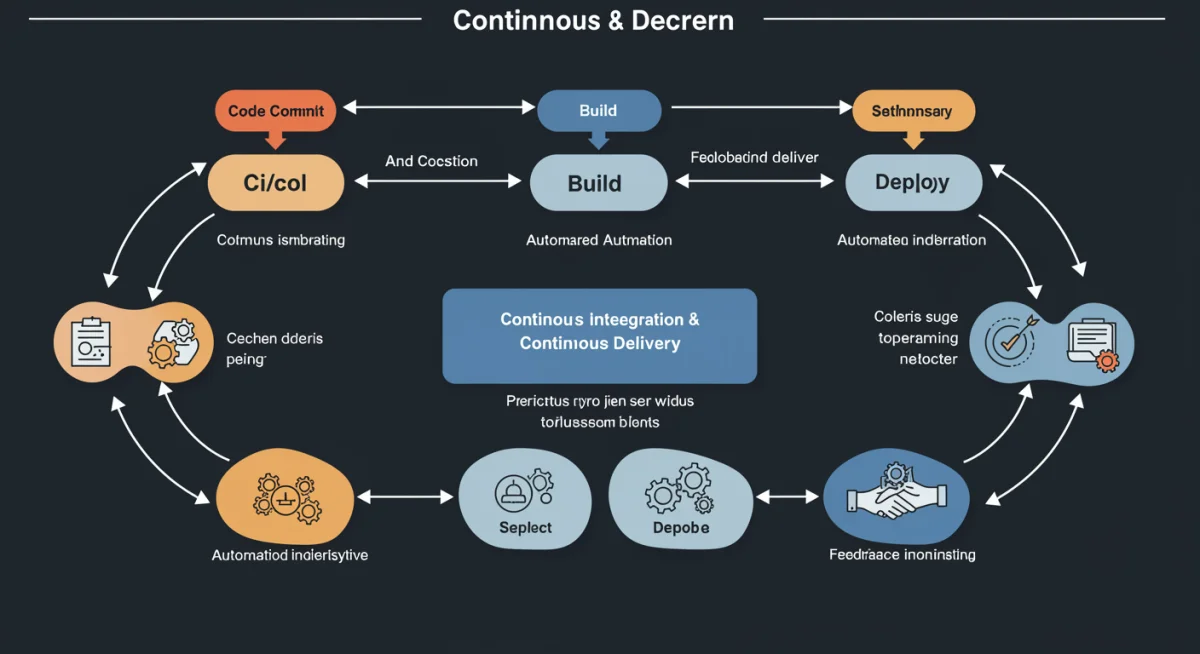
The chosen tools should integrate seamlessly with each other and with your existing systems. Prioritize open-source solutions where possible to leverage community support and avoid vendor lock-in. A well-planned technology stack will empower your team to build, test, and deploy faster, directly contributing to the targeted deployment acceleration.
implementing continuous integration and continuous delivery (CI/CD)
The backbone of successful DevOps automation for US software teams is a robust Continuous Integration (CI) and Continuous Delivery (CD) pipeline. Implementing CI/CD effectively is the most direct path to accelerating deployment cycles, as it automates the entire software release process from code commit to production. This systematic approach ensures that software is always in a releasable state.
Start with Continuous Integration. This involves setting up automated builds and unit tests to run every time a developer commits code to the shared repository. The goal is to detect and address integration issues as early as possible, preventing them from escalating into more complex and time-consuming problems later in the development cycle. Tools like Jenkins, GitLab CI/CD, or GitHub Actions are excellent for orchestrating these automated workflows. Ensure that your CI pipeline provides fast feedback to developers, allowing them to quickly iterate and fix any broken builds or failing tests.
steps for effective CI/CD implementation
- Automate Build Processes: Eliminate manual compilation and packaging.
- Automate Testing: Implement unit, integration, and end-to-end tests that run automatically with each build.
- Version Control Everything: Store all code, configurations, and scripts in a version control system.
- Streamline Deployment: Automate the process of deploying applications to development, staging, and production environments.
Once CI is stable, move to Continuous Delivery. This extends the automation to include the deployment of validated code to various environments. The objective here is to have a deployable artifact at any given moment, ready for release to production. This doesn’t mean every change goes live immediately, but rather that it can. Automated deployment scripts and tools like Ansible or Spinnaker become critical here, ensuring consistency and reliability across all environments.
By systematically implementing and refining your CI/CD pipelines, your team will significantly reduce manual effort, minimize errors, and dramatically cut down the time it takes to get new features and bug fixes into the hands of your users. This is a primary driver for achieving a 40% acceleration in deployment cycles.
integrating automated testing and quality gates
Accelerating deployment cycles is only beneficial if it doesn’t compromise software quality. For US software teams, integrating comprehensive automated testing and establishing robust quality gates within your DevOps pipeline is non-negotiable. This ensures that speed is matched with reliability, preventing defects from reaching production and maintaining customer trust.
Automated testing should be embedded at every stage of the CI/CD pipeline. This includes unit tests that run with every code commit, integration tests to verify interactions between different components, and end-to-end tests that simulate user scenarios. Performance testing, security scanning, and static code analysis should also be automated to catch issues early. Tools like Selenium for UI testing, JUnit for Java unit tests, and SonarQube for code quality analysis are widely adopted and can be integrated seamlessly.
establishing effective quality gates
Quality gates act as checkpoints in your pipeline, automatically halting the process if predefined criteria are not met. These criteria can include:
- Passing all unit and integration tests.
- Meeting code coverage thresholds.
- Satisfying security scan requirements (no critical vulnerabilities).
- Adhering to performance benchmarks.
For example, a pipeline might automatically fail if code coverage drops below 80% or if a critical security vulnerability is detected. This forces developers to address quality issues immediately, rather than pushing them downstream where they become more expensive and time-consuming to fix. Implementing these gates requires clear definitions of ‘done’ and ‘quality’ within your team, fostering a shared responsibility for product excellence.
By rigorously integrating automated testing and strategically placing quality gates, your team can achieve faster deployments with greater confidence. This dual focus on speed and quality is essential for delivering high-value software consistently and accelerating your deployment cycles without sacrificing the user experience.
monitoring, feedback, and continuous improvement
The journey of DevOps automation doesn’t end with deployment; it’s a continuous cycle of monitoring, feedback, and improvement. For US software teams aiming for sustained acceleration and reliability, establishing robust monitoring systems and creating feedback loops are paramount. This allows teams to quickly identify issues, understand system performance, and iteratively refine their automation strategies.
Effective monitoring involves collecting metrics across all stages of your pipeline and production environments. This includes application performance monitoring (APM), infrastructure monitoring, log aggregation, and user experience monitoring. Tools like Datadog, New Relic, Prometheus, and Grafana provide comprehensive visibility into your systems, allowing you to detect anomalies and preemptively address potential problems. Setting up alerts for critical issues ensures that teams are notified immediately, reducing downtime and impact.
leveraging feedback for optimization
- Post-Mortem Analysis: Conducting blameless post-mortems after incidents to identify root causes and implement preventive measures.
- Performance Reviews: Regularly reviewing pipeline performance metrics, such as deployment frequency, lead time for changes, and change failure rate.
- Developer Feedback: Gathering input from developers and operations teams on tool usability, process efficiency, and automation effectiveness.
- Customer Feedback: Incorporating user feedback into the development cycle to drive product enhancements.
By actively monitoring your automated pipelines and production systems, and by systematically collecting and acting on feedback, your team can continuously optimize its processes. This iterative approach ensures that your DevOps automation efforts remain aligned with business goals, leading to ongoing improvements in deployment speed, stability, and overall software quality. This commitment to continuous learning and adaptation is what will help US teams not only achieve but also sustain that 40% acceleration in deployment cycles.
| Key Aspect | Description for Acceleration |
|---|---|
| CI/CD Pipelines | Automates build, test, and deployment, reducing manual effort and errors. |
| Automated Testing | Ensures quality and stability at speed, catching defects early. |
| Infrastructure as Code | Manages infrastructure programmatically, ensuring consistent and rapid provisioning. |
| Monitoring & Feedback | Provides insights for continuous optimization and rapid issue resolution. |
frequently asked questions about devops automation for us teams
The primary benefit is significantly accelerated deployment cycles, leading to faster delivery of features and bug fixes. This improves market responsiveness, enhances customer satisfaction, and provides a competitive edge in the dynamic US tech landscape.
You can measure this by tracking key metrics like deployment frequency, lead time for changes, and the mean time to recovery (MTTR). Establish a baseline before automation and compare these metrics post-implementation to quantify your improvement.
Essential tools include a version control system (e.g., Git), a CI/CD platform (e.g., Jenkins, GitLab CI/CD), and potentially an Infrastructure as Code tool (e.g., Terraform). The specific choices depend on your existing tech stack and team expertise.
Absolutely. Automated testing is crucial. Accelerating deployments without robust automated tests can lead to more defects in production, undermining the benefits of speed. It ensures quality and confidence in rapid releases.
Initial improvements can be seen within weeks or a few months, especially by automating obvious bottlenecks. Achieving significant acceleration, like 40%, usually requires a sustained effort over several months as teams adapt and pipelines mature.
conclusion: embracing the future of software delivery
For US software teams, the pursuit of enhanced efficiency and speed in deployment cycles is an ongoing endeavor. This guide has laid out a comprehensive, step-by-step approach to leveraging DevOps automation, aiming to achieve a remarkable 40% acceleration in deployment cycles this year. By understanding the core tenets of DevOps, thoroughly assessing current processes, strategically selecting the right tools, and meticulously implementing CI/CD pipelines with integrated automated testing and quality gates, organizations can transform their software delivery capabilities. The final, yet equally critical, component involves establishing robust monitoring and feedback loops to ensure continuous improvement and adaptability. Embracing these principles and practices will not only streamline operations but also foster a culture of collaboration and innovation, positioning your team at the forefront of the competitive US tech landscape. The future of software delivery is automated, and the time to act is now.