Anúncios
Maximizing smartwatch battery life by 25% by 2026 involves strategically optimizing device settings, managing notifications, and adopting efficient charging and usage habits to significantly extend daily operational time.
In an increasingly connected world, our smartwatches have become indispensable companions, tracking our fitness, delivering notifications, and even facilitating payments. However, the Achilles’ heel for many remains battery life. Imagine unlocking an additional 25% of operational time from your device. This comprehensive guide provides actionable insights: maximizing your smartwatch battery life by 25% with these 7 expert tips for 2026, ensuring your wearable keeps pace with your dynamic lifestyle without constant recharging.
Understand Your Smartwatch’s Power Consumption
Before diving into optimization, it’s crucial to grasp what drains your smartwatch’s battery the most. Different functionalities consume varying amounts of power, and identifying these culprits is the first step towards effective management. Understanding your usage patterns allows for targeted adjustments, leading to more significant battery savings.
Anúncios
Many users are unaware of the energy demands placed on their devices by seemingly innocuous features. From constant heart rate monitoring to bright, animated watch faces, each element contributes to the overall power drain. By becoming more attuned to these factors, you can make informed decisions about which features are essential and which can be scaled back for longevity.
Identifying Battery Hogs
- Display Brightness and Always-On Displays: High brightness and screens that never turn off are major power consumers.
- GPS Usage: Activities requiring continuous GPS tracking, like running or cycling, deplete battery rapidly.
- Heart Rate Monitoring: Frequent or continuous heart rate tracking uses significant power.
- Notifications: An abundance of notifications, especially with vibrations, can be a constant drain.
By pinpointing these primary power consumers, you can begin to tailor your smartwatch’s settings to your specific needs, balancing functionality with battery endurance. This foundational understanding sets the stage for implementing more advanced saving techniques.
Optimize Display Settings for Longevity
The display is often the single most power-hungry component of any smartwatch. Smart adjustments to how your screen operates can yield substantial battery improvements, sometimes by as much as 10-15% alone. Focusing on this area offers one of the quickest returns on your optimization efforts.
Anúncios
Many smartwatches come with default settings that prioritize visual appeal over efficiency. While vibrant colors and high brightness are attractive, they are not always necessary for daily use. A slight reduction in brightness or a change in display behavior can make a noticeable difference in how long your device lasts between charges.
Adjusting Brightness and Timeout
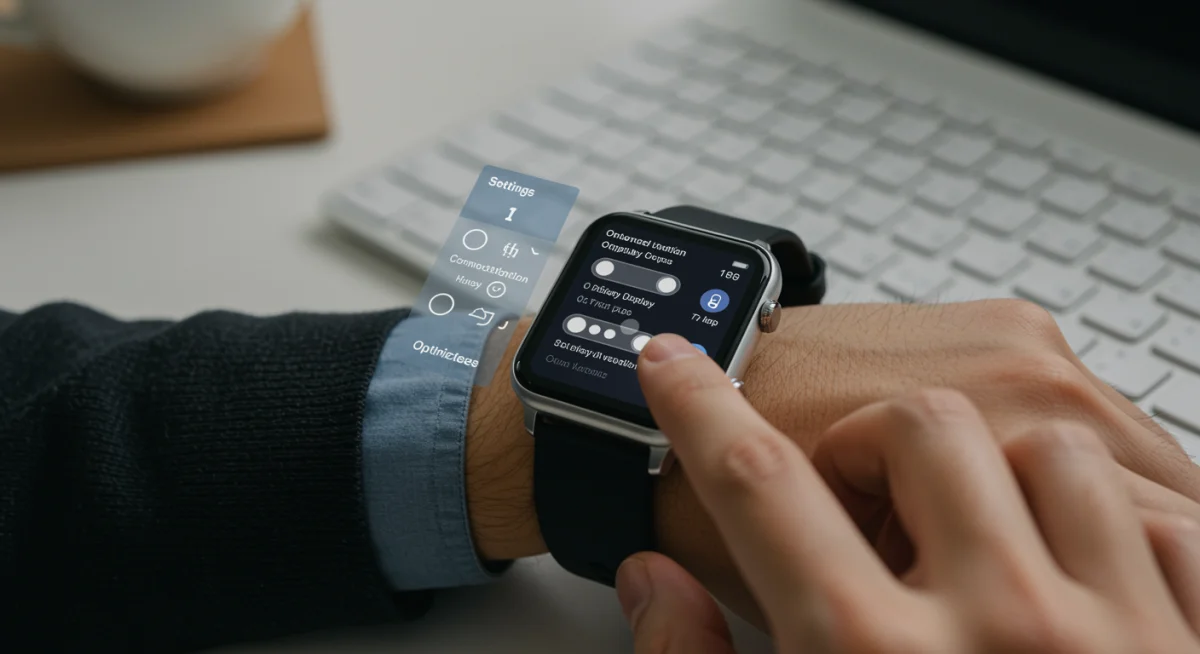
- Lower Brightness: Reduce the screen brightness to the lowest comfortable level. Automatic brightness can also be helpful but ensure it’s not overly aggressive.
- Shorter Screen Timeout: Set the screen to turn off more quickly after inactivity. Even a few seconds can add up over a day.
- Disable Always-On Display: While convenient, the always-on display feature significantly impacts battery life. Consider turning it off or using it only when absolutely necessary.
- Choose Simple Watch Faces: Animated, complex watch faces with many complications consume more power. Opt for minimalist designs.
These display modifications are simple yet incredibly effective. By being mindful of your screen’s settings, you can drastically reduce its power draw, contributing significantly to maximizing your smartwatch battery life.
Manage Notifications and Connectivity Wisely
Constant connectivity and a deluge of notifications, while central to the smartwatch experience, are significant battery drains. Each vibration, screen wake-up, and data sync consumes precious power. Strategic management of these features can extend your battery life considerably.
It’s easy to allow every app on your phone to push notifications to your wrist, but this often leads to unnecessary power consumption. Taking a moment to curate which notifications matter most can not only save battery but also reduce digital clutter and improve focus.
Selective Notification Control
- Filter Notifications: Go into your smartwatch app settings and disable notifications for non-essential applications. Only allow critical alerts to reach your wrist.
- Turn Off Vibration for Less Critical Alerts: Vibrations use more power than a simple screen wake-up. Reserve them for truly important notifications.
- Limit Wi-Fi and Cellular Connection: If your smartwatch has its own Wi-Fi or cellular connection, consider turning them off when not needed. Rely on Bluetooth connection to your phone where possible.
- Disable Unused Bluetooth Connections: Ensure your watch is only connected to necessary devices.
By carefully curating your notification stream and being judicious with connectivity options, you can significantly reduce the background activity that silently saps your smartwatch’s power, helping you extend its operational duration.
Optimize Health and Fitness Tracking
Health and fitness tracking are core functionalities of modern smartwatches, but they can be major power consumers. Continuous heart rate monitoring, GPS tracking for workouts, and sleep analysis all demand significant energy. Adjusting these settings can free up considerable battery capacity.
While the allure of comprehensive health data is strong, not everyone needs every metric tracked continuously. Assessing which data points are most valuable to you and adjusting the tracking frequency accordingly can strike a better balance between data collection and battery preservation.
Smart Tracking Adjustments
- Reduce Heart Rate Monitoring Frequency: Instead of continuous monitoring, change the setting to monitor every 10-30 minutes, or only during workouts.
- Use GPS Selectively: If you’re not actively tracking an outdoor workout, ensure GPS is turned off. Many watches offer a ‘phone GPS’ option which uses your phone’s GPS, saving watch battery.
- Disable SpO2 or Skin Temperature Tracking: If your watch offers these advanced health metrics, consider disabling them if they are not critical for your daily needs.
- Manual Workout Tracking: For short or infrequent workouts, consider starting and stopping tracking manually rather than relying on automatic detection.
These targeted adjustments to your health and fitness tracking settings allow you to maintain essential monitoring capabilities while significantly reducing the constant power drain associated with these features. This balance is key to maximizing your smartwatch battery life without sacrificing core benefits.
Implement Power-Saving Modes and Features
Most smartwatches today come equipped with dedicated power-saving modes designed to extend battery life when you need it most. These modes typically scale back functionalities in a coordinated way, and knowing when and how to use them can be a game-changer.
Power-saving modes are not just for emergencies; they can be integrated into your daily routine. For instance, activating a power-saving mode overnight or during periods of low activity can significantly conserve battery without you missing crucial information.
Leveraging Built-in Power Savers
Most modern smartwatches, regardless of brand, offer some form of power-saving options. These modes are designed to intelligently reduce power consumption by limiting specific functions. Understanding how your particular device implements these features is crucial for effective use. Typically, they can be accessed through the watch’s settings menu or a quick-settings panel.
- Activate Low Power Mode: Many watches have a dedicated low power or battery saver mode. This often disables non-essential features like Wi-Fi, cellular, and always-on display, extending battery life substantially.
- Scheduled Power Modes: Some smartwatches allow you to schedule power-saving modes, for example, activating automatically during your sleep hours or when you’re in a known Wi-Fi zone.
- Disable Voice Assistant: If you don’t frequently use your voice assistant, disabling ‘Hey Siri’ or ‘Ok Google’ detection can save a surprising amount of power.
- Regular Software Updates: Manufacturers often release updates that include battery optimizations. Keeping your smartwatch’s software up to date ensures you benefit from these improvements.
By proactively utilizing your smartwatch’s power-saving capabilities, you can ensure it lasts longer on a single charge, providing peace of mind and reducing the frequency of charging cycles. These modes are an underutilized tool in the quest for extended battery life.
Adopt Smart Charging Habits and Maintenance
Beyond software and display settings, how you charge and maintain your smartwatch plays a critical role in its battery health and longevity. Poor charging habits can degrade the battery over time, leading to reduced capacity and shorter daily usage.
Just like any other rechargeable device, smartwatch batteries have a finite number of charge cycles. Optimizing these cycles and performing regular maintenance can ensure the battery performs optimally for as long as possible, contributing to sustained performance in the long run.
Best Practices for Battery Health
Maintaining optimal battery health goes beyond just charging; it involves a holistic approach to how you interact with your device’s power source. Overcharging, deep discharging, and exposure to extreme temperatures are all factors that can accelerate battery degradation. Being mindful of these aspects can significantly prolong your smartwatch’s overall battery lifespan.
- Avoid Full Discharges: Don’t let your smartwatch battery drain completely to 0% regularly. Lithium-ion batteries perform best when kept between 20% and 80% charge.
- Don’t Overcharge: While modern smartwatches have safeguards, regularly leaving your watch on the charger overnight after it’s reached 100% can still contribute to long-term degradation. Unplug it once fully charged.
- Use Original Chargers: Always use the charger provided by the manufacturer or a reputable third-party alternative to ensure proper charging voltage and current.
- Keep Software Updated: As mentioned, software updates often include battery management enhancements, so keep your device’s firmware current.
- Avoid Extreme Temperatures: High heat or extreme cold can negatively impact battery performance and longevity. Avoid leaving your smartwatch in direct sunlight or freezing conditions.
By integrating these smart charging and maintenance practices into your routine, you can not only extend your daily smartwatch battery life but also preserve the overall health and capacity of its battery for years to come. This proactive approach is fundamental for long-term device satisfaction.
Future-Proofing Your Battery Strategy for 2026
As technology evolves, so do the capabilities and demands on smartwatch batteries. Looking ahead to 2026, anticipating future trends and incorporating advanced strategies will be crucial for maintaining optimal battery performance. This involves staying informed about new features and understanding their potential power implications.
The smartwatch landscape is constantly changing, with advancements in sensors, connectivity, and processing power. While these innovations bring exciting new functionalities, they often come with increased energy requirements. A forward-thinking approach to battery management ensures you can enjoy these advancements without constantly worrying about your device dying.
Anticipating 2026 Innovations
The year 2026 promises even more sophisticated smartwatches, potentially featuring advanced biometric sensors, richer display technologies, and more robust independent connectivity. These innovations, while exciting, will undoubtedly place new demands on battery technology. Preparing for these changes now will ensure your current and future devices remain efficient.
- Research New Features: Before a new smartwatch purchase, research how new sensors (e.g., advanced blood glucose monitoring, continuous blood pressure) might impact battery life.
- Leverage AI-Driven Optimization: Expect more smartwatches to incorporate AI for predictive battery management, learning your usage patterns to optimize power consumption dynamically. Utilize these features as they become available.
- Invest in Power Banks: For extended trips or days away from chargers, a compact, portable power bank specifically designed for wearables can be a lifesaver.
- Consider Upgrading: If your current smartwatch battery health has significantly degraded despite all efforts, a newer model with more efficient hardware and a fresh battery might be the most practical solution for 2026.
By staying ahead of the curve and adapting your battery strategy to future technological advancements, you can ensure your smartwatch continues to deliver peak performance and extended battery life well into 2026 and beyond. This proactive mindset is essential for any tech enthusiast.
| Key Optimization Area | Brief Description |
|---|---|
| Display Settings | Reduce brightness, shorten screen timeout, use simple watch faces. |
| Notifications & Connectivity | Filter alerts, limit Wi-Fi/cellular, disable unnecessary vibrations. |
| Health Tracking | Adjust heart rate frequency, use GPS selectively for workouts. |
| Power-Saving Modes | Utilize built-in low power modes and keep software updated. |
Frequently Asked Questions About Smartwatch Battery Life
Implementing a combination of these tips can realistically extend your smartwatch battery life by 20-30%. The exact percentage depends on your device model, original usage patterns, and how many recommendations you apply consistently. Small changes accumulate to significant gains.
Yes, always-on displays are one of the most significant battery drains. While convenient, keeping the screen constantly active, even at a lower brightness, consumes substantially more power than a display that activates only when you raise your wrist or tap it.
Absolutely. Continuous heart rate monitoring requires the optical sensor to be constantly active, which is a power-intensive process. Reducing its frequency (e.g., to every 10-30 minutes or only during workouts) can lead to notable battery savings over a day.
No, it’s generally advised against letting lithium-ion batteries, like those in smartwatches, fully discharge to 0% regularly. Optimal battery health is maintained by keeping the charge between 20% and 80%, avoiding both full drains and prolonged 100% charges.
Often, yes. Third-party watch faces may not be as optimized for power efficiency as official ones. They might feature more animations, complex graphics, or inefficient code that leads to higher battery consumption. Sticking to simpler, well-optimized faces is usually better for battery life.
Conclusion
Achieving a significant boost in your smartwatch’s battery life by 2026 is not merely a wish but a tangible goal through diligent application of these expert tips. By understanding your device’s power consumption, optimizing display settings, managing notifications, fine-tuning health tracking, leveraging power-saving modes, and adopting smart charging habits, you can extend your wearable’s endurance by a remarkable 25% or more. These actionable insights empower you to make your smartwatch a more reliable and enduring companion, ready to support your day-to-day activities without the constant worry of a dying battery.