Predictive Analytics with AI: US Business Optimization 2026

Predictive analytics with AI offers US businesses a powerful framework to anticipate market changes, optimize resource allocation, and enhance customer experiences, driving significant operational improvements by 2026.
In today’s rapidly evolving business landscape, staying ahead means anticipating the future, not just reacting to the present. For US businesses aiming to thrive by 2026, the strategic implementation of predictive analytics with AI is no longer an option but a necessity. This guide provides a clear, step-by-step roadmap to harness this transformative technology, ensuring optimized operations and sustained competitive advantage.
Understanding Predictive Analytics and AI Synergy
Predictive analytics, at its core, involves using historical data to forecast future outcomes. When augmented with artificial intelligence (AI), its capabilities expand exponentially, allowing for more accurate predictions, automated insights, and the ability to process vast, complex datasets that would overwhelm traditional methods. This synergy empowers US businesses to move beyond simple trend analysis, delving into nuanced patterns that reveal opportunities and risks.
The integration of AI algorithms, such as machine learning and deep learning, transforms raw data into actionable intelligence. These algorithms can identify subtle correlations, detect anomalies, and even learn from new data, continuously refining their predictive models. For businesses, this means more precise demand forecasting, optimized supply chains, and personalized customer engagement strategies, all contributing to a more resilient and efficient operational framework.
The power of machine learning in predictions
Machine learning (ML) models are the workhorses of AI-powered predictive analytics. They are trained on historical data to recognize patterns and make predictions without explicit programming. This adaptive nature makes them incredibly valuable for dynamic business environments.
- Regression models: Used for predicting continuous values, like sales figures or stock prices.
- Classification models: Ideal for categorizing data, such as identifying potential customer churn or fraud risks.
- Clustering algorithms: Group similar data points, useful for market segmentation and personalized marketing.
By leveraging these diverse ML techniques, businesses can construct sophisticated predictive models tailored to their specific operational challenges. The ability to process and learn from massive datasets gives these models an edge over traditional statistical methods, offering granular insights that were previously unattainable.
In conclusion, the combination of predictive analytics and AI is not merely an incremental improvement; it’s a paradigm shift. It offers US businesses the tools to foresee and adapt, turning data into a strategic asset that drives operational excellence and fosters innovation across all departments.
Defining Your Business Objectives and Data Strategy
Before embarking on any AI initiative, clearly defining your business objectives is paramount. What specific problems are you trying to solve? What operational areas need improvement? Without a clear vision, even the most advanced predictive models will struggle to deliver tangible value. This initial phase sets the foundation for a successful implementation, ensuring that your efforts are aligned with strategic business goals.
Once objectives are established, the next critical step is to develop a robust data strategy. Predictive analytics is only as good as the data it consumes. This involves identifying relevant data sources, assessing data quality, and establishing processes for data collection, storage, and governance. A comprehensive data strategy ensures that the right data is available, accessible, and reliable for your AI models.
Identifying key performance indicators (KPIs)
To measure the success of your predictive analytics initiatives, it’s essential to define relevant KPIs. These metrics will serve as benchmarks against which you can evaluate the performance of your models and the impact on your business operations.
- Reduced operational costs: Tracking savings from optimized resource allocation or predictive maintenance.
- Increased revenue: Measuring growth driven by improved sales forecasts or personalized marketing campaigns.
- Enhanced customer satisfaction: Monitoring metrics like churn rate or customer feedback scores.
A well-defined data strategy also encompasses data governance, ensuring compliance with privacy regulations and maintaining data security. This is particularly crucial for US businesses operating under stringent data protection laws. Investing in data cleanliness and accessibility from the outset will save significant time and resources later in the project.
In summary, a clear understanding of business objectives coupled with a meticulous data strategy forms the bedrock of any successful predictive analytics implementation. This foundational work ensures that your AI models are built on solid ground and are directly contributing to your strategic business outcomes.
Data Collection, Preparation, and Feature Engineering
The journey from raw data to predictive insights is heavily reliant on effective data collection, thorough preparation, and intelligent feature engineering. This phase is often the most time-consuming yet critical, as the quality of your data directly impacts the accuracy and reliability of your AI models. US businesses must invest significant effort here to unlock the true potential of predictive analytics.
Data collection involves gathering relevant historical and real-time data from various internal and external sources. This could include sales records, customer interactions, sensor data, market trends, and even social media sentiment. The challenge lies in integrating these disparate datasets into a unified and coherent format suitable for analysis.
The importance of clean and relevant data
Data preparation is where raw data is transformed into a clean, consistent, and usable format. This often involves several crucial steps:
- Data cleaning: Identifying and correcting errors, inconsistencies, and missing values.
- Data transformation: Converting data into a suitable format for algorithms, such as normalization or standardization.
- Data integration: Combining data from multiple sources into a single, cohesive dataset.
Feature engineering is the art and science of creating new variables (features) from existing data to improve the performance of machine learning models. This step requires domain expertise and creativity, as well as an understanding of how different features might influence the predictive outcome. For example, combining individual transaction data to create a ‘customer lifetime value’ feature can significantly enhance customer churn prediction models.
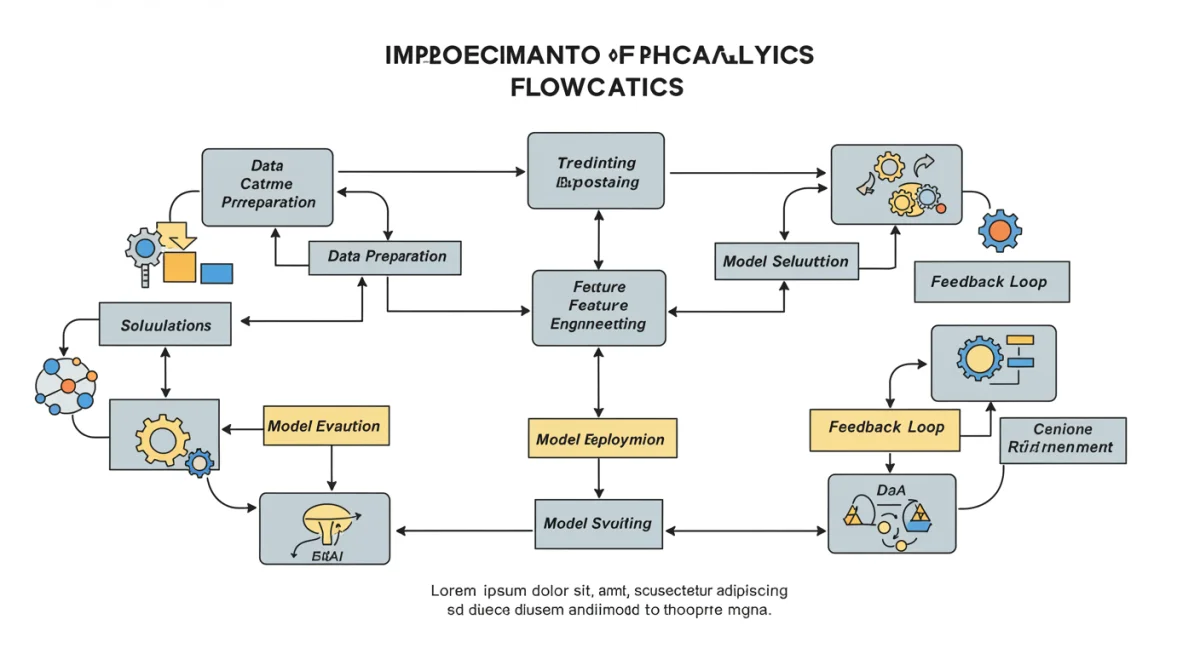
This meticulous process of data collection, preparation, and feature engineering is not a one-time task but an ongoing effort. As new data becomes available and business objectives evolve, these steps must be revisited to ensure the predictive models remain accurate and relevant. For US businesses, mastering this stage is a key differentiator in achieving superior operational insights.
Model Selection, Training, and Validation
Once your data is clean and features are engineered, the next crucial step is selecting the appropriate AI models, training them with your prepared data, and rigorously validating their performance. This phase demands a deep understanding of various machine learning algorithms and their suitability for different types of predictive tasks. The goal is to choose models that not only provide accurate predictions but also align with your business objectives.
Model selection involves evaluating different algorithms based on the nature of your data and the specific problem you’re trying to solve. For instance, linear regression might be suitable for simple forecasting, while more complex neural networks could be necessary for intricate pattern recognition in large datasets. It’s often beneficial to experiment with multiple models to determine which performs best.
Key steps in model development
Training an AI model involves feeding it the prepared data, allowing it to learn patterns and relationships. This process typically requires significant computational resources and careful tuning of model parameters.
- Splitting data: Dividing your dataset into training, validation, and test sets.
- Algorithm selection: Choosing the most appropriate machine learning algorithm for your task.
- Parameter tuning: Optimizing model settings to achieve the best performance.
Validation is critical to ensure that your model is not only accurate on historical data but can also generalize well to new, unseen data. Techniques like cross-validation help assess the model’s robustness and prevent overfitting. Performance metrics such as accuracy, precision, recall, and F1-score are used to quantify how well the model is performing against established benchmarks.
For US businesses, this iterative process of selection, training, and validation is essential for building confidence in the predictive models. A well-validated model provides reliable insights, enabling data-driven decision-making that can significantly impact operational efficiency and strategic planning.
Deployment and Integration into Business Workflows
Developing a powerful predictive AI model is only half the battle; the true value is realized when it’s seamlessly deployed and integrated into existing business workflows. This step transforms theoretical insights into practical, actionable intelligence that can drive real-time operational improvements. For US businesses, effective deployment ensures that the investment in AI translates into tangible benefits across the organization.
Deployment involves making the trained model accessible for predictions in a production environment. This could mean integrating it into an existing enterprise resource planning (ERP) system, a customer relationship management (CRM) platform, or a custom application. The goal is to automate the prediction process, allowing business users to leverage AI insights without needing deep technical expertise.
Ensuring smooth operational integration
Successful integration requires careful planning and collaboration between data scientists, IT professionals, and business stakeholders. Key considerations include:
- API development: Creating interfaces that allow other systems to interact with the predictive model.
- Scalability: Ensuring the model can handle increasing data volumes and prediction requests.
- Monitoring: Setting up systems to track model performance and detect degradation over time.
Beyond technical integration, it’s crucial to consider the human element. Training employees on how to interpret and act upon AI-generated predictions is vital. This involves fostering a data-driven culture where insights are trusted and used to inform daily operations and strategic decisions. Change management strategies can help facilitate this transition and ensure widespread adoption.
Ultimately, the successful deployment and integration of predictive AI models empower US businesses to automate decision-making, optimize resource allocation, and respond more agilely to market dynamics. This seamless operationalization is what truly unlocks the transformative power of AI for sustained business growth.
Monitoring, Refinement, and Ethical Considerations
The journey with predictive analytics and AI doesn’t end with deployment; it’s an ongoing cycle of monitoring, refinement, and continuous improvement. AI models are not static entities; they require constant oversight to ensure their accuracy and relevance in a dynamic business environment. For US businesses, maintaining the integrity and performance of these models is crucial for sustained operational optimization.
Continuous monitoring involves tracking the model’s performance against real-world outcomes. This includes observing prediction accuracy, identifying potential biases, and detecting data drift – where the characteristics of incoming data change over time, making the model less effective. Regular performance reviews are essential to catch issues before they impact business operations significantly.
Addressing ethical AI challenges
Refinement is the process of updating and retraining models with new data to maintain or improve their accuracy. This iterative process ensures that the models remain current and responsive to evolving market conditions, customer behaviors, or internal operational changes. It might involve recalibrating parameters, incorporating new features, or even switching to a different algorithm if performance significantly degrades.
- Bias detection: Actively seeking out and mitigating biases in data and algorithms.
- Transparency: Ensuring stakeholders understand how predictions are made.
- Accountability: Establishing clear responsibilities for AI model outcomes.
Furthermore, ethical considerations are paramount in the development and deployment of AI. US businesses must proactively address issues such as data privacy, algorithmic bias, fairness, and transparency. Establishing clear ethical guidelines and ensuring compliance with regulations like GDPR or CCPA is not just a legal requirement but a fundamental aspect of building trust with customers and stakeholders.
In conclusion, effective monitoring, continuous refinement, and a strong commitment to ethical AI practices are vital for maximizing the long-term value of predictive analytics. By embracing this ongoing process, US businesses can ensure their AI initiatives remain robust, responsible, and a true driver of operational excellence well into 2026 and beyond.
| Key Stage | Brief Description |
|---|---|
| Define Objectives | Clearly articulate business goals and develop a robust data strategy. |
| Data Preparation | Collect, clean, and engineer features from diverse data sources. |
| Model Development | Select, train, and rigorously validate AI models for accuracy. |
| Deployment & Monitoring | Integrate models into workflows and continuously monitor performance. |
Frequently Asked Questions About Predictive Analytics with AI
Predictive analytics with AI combines historical data and advanced algorithms, like machine learning, to forecast future outcomes. It helps businesses anticipate trends, identify risks, and make data-driven decisions to optimize operations and strategy.
It’s crucial for gaining a competitive edge, optimizing resource allocation, enhancing customer experiences, and adapting quickly to market changes. By 2026, businesses not leveraging AI for predictions risk falling behind more agile competitors.
Begin by clearly defining your business objectives and developing a comprehensive data strategy. This includes identifying key problems to solve and ensuring you have access to clean, relevant data for analysis and model training.
Ensuring data quality involves rigorous data cleaning, transformation, and integration processes. Regularly auditing data sources, correcting inconsistencies, and establishing strong data governance policies are essential for reliable AI predictions.
Businesses must address data privacy, algorithmic bias, fairness, and transparency. Developing clear ethical guidelines, complying with regulations like CCPA, and ensuring accountability in AI decision-making are critical for building trust and responsible AI use.
Conclusion
The strategic adoption of predictive analytics with AI is undeniably a cornerstone for operational excellence and sustained growth for US businesses by 2026. This comprehensive guide has outlined a clear, actionable path from defining objectives to continuous monitoring and refinement. By investing in robust data strategies, thoughtful model development, seamless integration, and a strong commitment to ethical AI, businesses can unlock unparalleled insights, automate complex decisions, and navigate the future with greater confidence and agility. The era of proactive business is here, and AI-powered predictive analytics is the key to unlocking its full potential.