Quantum Cryptography: 2026’s Unbreakable Data Protection Methods
Quantum cryptography in 2026 is poised to deliver fundamentally unbreakable encryption, utilizing quantum mechanics to safeguard sensitive data from emerging and future cyber threats, including those posed by quantum computers.
As we navigate the increasingly complex digital landscape, the quest for truly impenetrable data security has become paramount. Traditional encryption methods, while robust, face an existential threat from the impending advent of quantum computing. This is where Quantum Cryptography: Protecting Data with 2026’s Unbreakable Encryption Methods emerges as a beacon of hope, promising a future where data remains secure, regardless of computational advancements. This revolutionary field harnesses the bizarre yet powerful principles of quantum mechanics to create encryption that is, in theory, uncrackable.
Understanding the Quantum Leap in Cryptography
Quantum cryptography represents a paradigm shift from classical encryption. Instead of relying on complex mathematical problems that are hard for current computers to solve, it utilizes the inherent laws of physics to guarantee security. This fundamental difference is what makes it so revolutionary, offering a level of protection previously unimaginable.
The core concept revolves around quantum mechanics, particularly superposition and entanglement. These principles allow for the creation and distribution of cryptographic keys that are inherently secure. Any attempt to observe or intercept these keys alters their quantum state, immediately alerting the communicating parties to a breach. This ‘unhackable’ nature is what sets quantum cryptography apart from its classical counterparts.
The Foundations of Quantum Mechanics
To grasp quantum cryptography, it’s essential to understand its quantum underpinnings. Superposition allows a quantum bit (qubit) to exist in multiple states simultaneously, unlike classical bits that are either 0 or 1. Entanglement, on the other hand, links two or more qubits in such a way that they share the same fate, regardless of distance. Measuring one instantly affects the others.
- Superposition: Qubits can be 0, 1, or both simultaneously.
- Entanglement: Linked qubits share properties, even when separated.
- No-Cloning Theorem: It’s impossible to perfectly copy an unknown quantum state.
These quantum phenomena are not just theoretical curiosities; they are the bedrock upon which the impenetrable security of quantum cryptography is built. The act of observation fundamentally changes the system, making passive eavesdropping impossible. This physical law-based security is far more robust than mathematically based security, which can eventually be broken by more powerful computers.
In essence, quantum cryptography doesn’t just make it difficult for an attacker; it makes it physically impossible to intercept a key without detection. This provides a level of assurance that classical cryptography simply cannot match, especially as quantum computing advances.
Quantum Key Distribution (QKD): The Backbone of Quantum Security
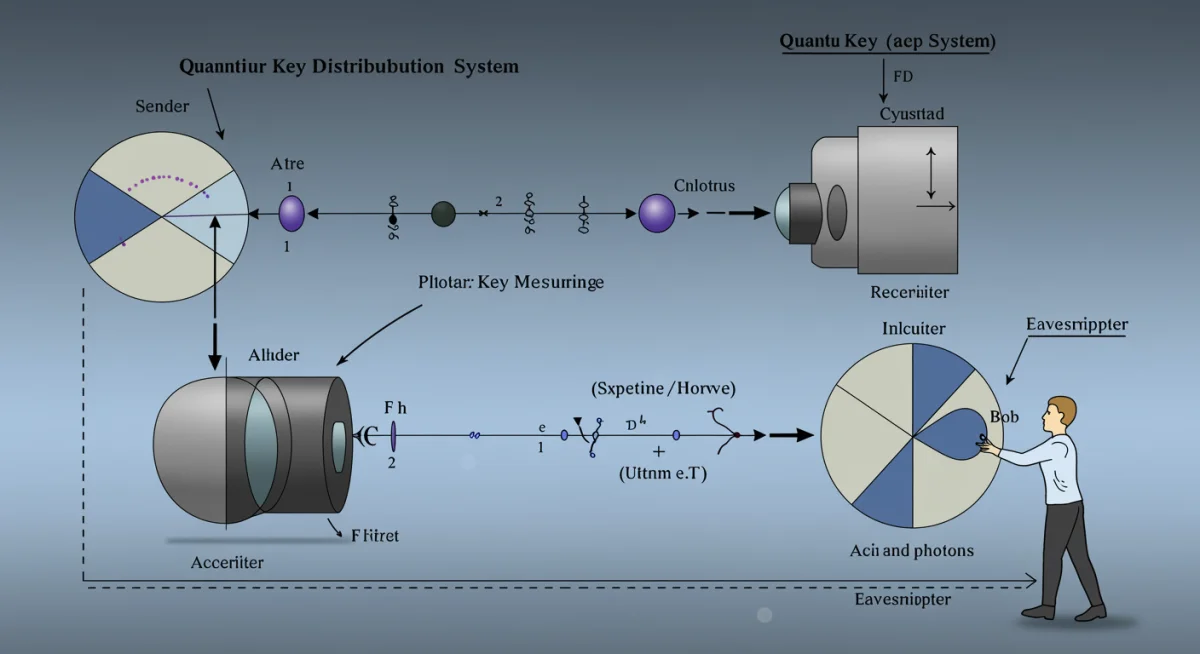
Quantum Key Distribution (QKD) is the most developed and widely recognized application of quantum cryptography. It’s a method for securely exchanging cryptographic keys between two parties, often referred to as Alice and Bob, using the principles of quantum mechanics. The security of QKD lies in the fact that any attempt by an eavesdropper, Eve, to measure the quantum states being transmitted will inevitably disturb them, thus revealing Eve’s presence.
The process typically involves Alice sending individual photons, each encoded with a random bit (0 or 1), to Bob. The encoding uses different polarization states for the photons. Bob then randomly chooses a measurement basis to read these photons. After the transmission, Alice and Bob publicly compare a subset of their choices and measurements to detect any discrepancies that would indicate an eavesdropper.
How QKD Ensures Unbreakable Keys
The magic of QKD is that if Eve tries to intercept and read the photons, her measurement will inevitably collapse the photon’s superposition, changing its state. When Alice and Bob compare their results, they will find errors that exceed a certain threshold, immediately signaling a security breach. They can then discard the compromised key and try again.
- Photon Transmission: Alice sends polarized photons to Bob.
- Random Basis Selection: Both Alice and Bob randomly choose measurement bases.
- Public Reconciliation: They compare a subset of choices to detect eavesdropping.
- Error Detection: Anomalies indicate a compromised key, which is then discarded.
This detection mechanism is what makes QKD so powerful. Unlike classical cryptography, where an attacker might secretly copy a key, the no-cloning theorem of quantum mechanics prevents perfect copying of unknown quantum states. This means Eve cannot obtain a copy of the key without leaving a trace.
The practical implementation of QKD involves specialized hardware and sophisticated protocols, but the underlying principle remains elegantly simple: the laws of physics guarantee security. This makes QKD an essential component of future secure communication networks, offering protection against both classical and quantum computing attacks.
Challenges and Limitations in Deploying Quantum Cryptography
While the theoretical promise of quantum cryptography is immense, its practical widespread deployment faces several significant challenges. These range from the technical complexities of implementing quantum systems over long distances to the inherent costs and infrastructure requirements. Overcoming these hurdles is crucial for quantum cryptography to move from specialized applications to mainstream use.
One major limitation is the distance over which QKD can effectively operate. Photons, the carriers of quantum information, can be lost or decohere over long optical fiber links. This attenuation limits the practical range of QKD to a few hundred kilometers, making global quantum networks difficult to establish without intermediate trusted relays, which introduce new security considerations.
Overcoming Distance and Infrastructure Issues
Researchers are actively exploring solutions to these distance limitations. Quantum repeaters, which can amplify and re-transmit quantum signals without destroying their quantum state, are a promising but still nascent technology. Satellite-based QKD is another avenue, leveraging the vacuum of space to minimize photon loss, thus enabling intercontinental quantum key distribution.
- Distance Limitations: Photon loss and decoherence restrict QKD range.
- Infrastructure Costs: Specialized hardware and fiber optic networks are expensive.
- Quantum Repeaters: Promising technology for extending range, still in development.
- Satellite QKD: Offers potential for global quantum networks by overcoming terrestrial limitations.
Beyond distance, the current cost and complexity of quantum cryptographic hardware are substantial. Integrating these systems into existing communication infrastructures requires significant investment and expertise. Standardization efforts are also ongoing to ensure interoperability and broad adoption of quantum security protocols.
Despite these challenges, the progress in quantum cryptography is rapid. As technology matures and research breakthroughs occur, many of these limitations are expected to diminish, paving the way for more robust and accessible quantum-secure communication systems in the coming years.
The Quantum Threat: Why We Need Unbreakable Encryption
The urgency to develop and deploy advanced cryptographic solutions like quantum cryptography stems directly from the looming threat posed by quantum computers. While still in their early stages, these powerful machines have the potential to break many of the encryption algorithms that currently secure our digital world, including those protecting financial transactions, government secrets, and personal data.
Shor’s algorithm, for instance, a theoretical quantum algorithm, can efficiently factor large numbers, which is the mathematical basis for widely used public-key cryptographic systems like RSA and ECC. If a sufficiently powerful quantum computer becomes available, these systems could be compromised, leading to widespread data breaches and a collapse of current digital trust.
Post-Quantum Cryptography vs. Quantum Cryptography
It’s important to distinguish between post-quantum cryptography (PQC) and quantum cryptography. PQC refers to classical cryptographic algorithms that are designed to be resistant to attacks by quantum computers. These are software-based solutions that can be implemented on existing hardware. Quantum cryptography, like QKD, uses quantum mechanics to create inherently secure keys.
- Shor’s Algorithm: Threatens RSA and ECC encryption.
- Grover’s Algorithm: Can speed up brute-force attacks on symmetric keys.
- PQC: Software-based, quantum-resistant classical algorithms.
- Quantum Cryptography: Hardware-based, physics-guaranteed security.
While PQC offers a more immediate and flexible solution for many applications, quantum cryptography provides a fundamentally higher level of security, rooted in the laws of physics. The two approaches are often seen as complementary, with PQC addressing the near-term threat to existing infrastructure and quantum cryptography providing the ultimate long-term security solution.
The race to develop and implement quantum-resistant solutions is on. Organizations and governments worldwide are actively investing in research and development to prepare for the quantum era, ensuring that our data remains secure even in the face of unprecedented computational power.
Applications and Future Prospects of Quantum Cryptography by 2026
By 2026, quantum cryptography is expected to move beyond experimental setups and into more tangible, practical applications, particularly in sectors where data security is absolutely critical. While mass consumer adoption might still be a few years away, its impact on high-security environments will be significant, setting new benchmarks for data protection.
Governments, defense agencies, and financial institutions are at the forefront of adopting QKD. These entities handle highly sensitive information where the cost of a data breach is astronomical. Quantum security offers them an unparalleled level of assurance, protecting classified communications, financial transactions, and critical infrastructure from both current and future threats.
Key Sectors Embracing Quantum Security
The financial sector, in particular, is keenly interested in quantum cryptography to secure high-value transactions and protect customer data. The long-term security offered by QKD is ideal for safeguarding financial records that need to remain confidential for decades. Healthcare, with its vast amounts of personal and sensitive medical data, is another prime candidate for early adoption.
- Government and Defense: Securing classified communications and national intelligence.
- Financial Institutions: Protecting high-value transactions and long-term financial data.
- Healthcare: Safeguarding sensitive patient records and medical research.
- Critical Infrastructure: Ensuring the resilience of power grids and communication networks.
Looking further ahead, quantum cryptography is also poised to play a crucial role in securing the Internet of Things (IoT) and smart cities, where countless devices will be generating and exchanging sensitive data. Its integration with existing communication networks will be a gradual process, but the foundational work is being laid now.
By 2026, we anticipate seeing more commercial QKD products entering the market, along with increased interoperability standards. This will facilitate broader adoption and pave the way for a more quantum-secure digital future, even as quantum computing capabilities continue to grow.
Integrating Quantum Security into Existing Infrastructures
The transition to a quantum-secure world isn’t about replacing all existing infrastructure overnight; it’s about strategically integrating quantum security solutions into current systems. This involves a careful balance of upgrading hardware, implementing new protocols, and ensuring compatibility with legacy systems. The goal is to enhance security without disrupting essential services.
One of the primary integration challenges is the need for dedicated optical fiber links for QKD, as quantum signals cannot be easily multiplexed with classical data without compromising security. This often means laying new fiber or dedicating existing dark fiber, which can be expensive and time-consuming. However, advancements in quantum technology are exploring ways to overcome this limitation.
Hybrid Architectures and Gradual Adoption
Many organizations are considering hybrid security architectures that combine classical encryption with quantum security. For instance, a classical encrypted communication channel could be secured by keys distributed via QKD. This layered approach provides robust protection while allowing for a phased transition.
- Dedicated Fiber: QKD often requires separate optical fiber for quantum signals.
- Hybrid Systems: Combining classical encryption with quantum key distribution for enhanced security.
- Standardization: Developing protocols for interoperability and seamless integration.
- Cost-Benefit Analysis: Evaluating the investment against the risk of quantum attacks.
The development of standardized interfaces and protocols is critical for seamless integration. Organizations like the European Telecommunications Standards Institute (ETSI) are actively working on these standards to ensure that QKD systems from different vendors can interoperate and be integrated into global networks. This collaborative effort is essential for the broad adoption of quantum security.
By 2026, we expect to see more pilot programs and early deployments demonstrating successful integration of quantum cryptography into critical infrastructure. This gradual, well-planned approach will ensure that the benefits of unbreakable encryption are realized without undermining the stability of our current digital ecosystems.
| Key Aspect | Brief Description |
|---|---|
| Quantum Mechanics Base | Utilizes superposition and entanglement for inherently secure communication. |
| Quantum Key Distribution (QKD) | Method for securely exchanging cryptographic keys, detecting any eavesdropping attempt. |
| Quantum Threat | Quantum computers can break current encryption, necessitating new methods. |
| 2026 Outlook | Increased adoption in critical sectors, with ongoing efforts to overcome deployment challenges. |
Frequently Asked Questions about Quantum Cryptography
Quantum cryptography is considered unbreakable because it relies on the fundamental laws of quantum mechanics. Any attempt to observe or copy the quantum state of the transmitted keys inevitably alters them, immediately alerting the communicating parties to an eavesdropper’s presence. This physical detection mechanism makes it fundamentally more secure than classical encryption.
QKD works by exchanging cryptographic keys using individual photons encoded with quantum information. If an eavesdropper tries to intercept these photons, their quantum state is disturbed, creating detectable errors. Alice and Bob can then identify the intrusion and discard the compromised key, ensuring the exchanged key remains secret between them.
Quantum cryptography (like QKD) uses quantum mechanics for inherently secure key exchange, requiring specialized hardware. Post-quantum cryptography (PQC) consists of classical algorithms designed to be resistant to attacks by quantum computers, implementable on existing hardware. PQC is a software solution, while quantum cryptography is a hardware-based, physics-driven security.
Key challenges include distance limitations due to photon loss, requiring quantum repeaters or satellite links. High infrastructure costs, the need for dedicated optical fibers, and the complexity of integrating new quantum hardware into existing networks are also significant hurdles. Standardization efforts are ongoing to address interoperability.
By 2026, sectors requiring the highest levels of data security will benefit most, including government and defense agencies for classified communications, financial institutions for high-value transactions, and healthcare for sensitive patient data. Critical infrastructure will also adopt quantum security to protect essential services from advanced cyber threats.
Conclusion
The journey towards a quantum-secure future is well underway, with Quantum Cryptography: Protecting Data with 2026’s Unbreakable Encryption Methods leading the charge. While challenges in deployment and infrastructure integration remain, the fundamental promise of physics-based, uncrackable encryption is too significant to ignore. As quantum computing capabilities advance, the imperative to adopt quantum-resistant solutions becomes increasingly urgent. By 2026, we anticipate seeing quantum cryptography playing a pivotal role in safeguarding our most critical data, ensuring a level of digital security that was once confined to the realm of science fiction. The collaboration between researchers, governments, and industries will be key to realizing this transformative potential and building a truly resilient digital ecosystem for the years to come.